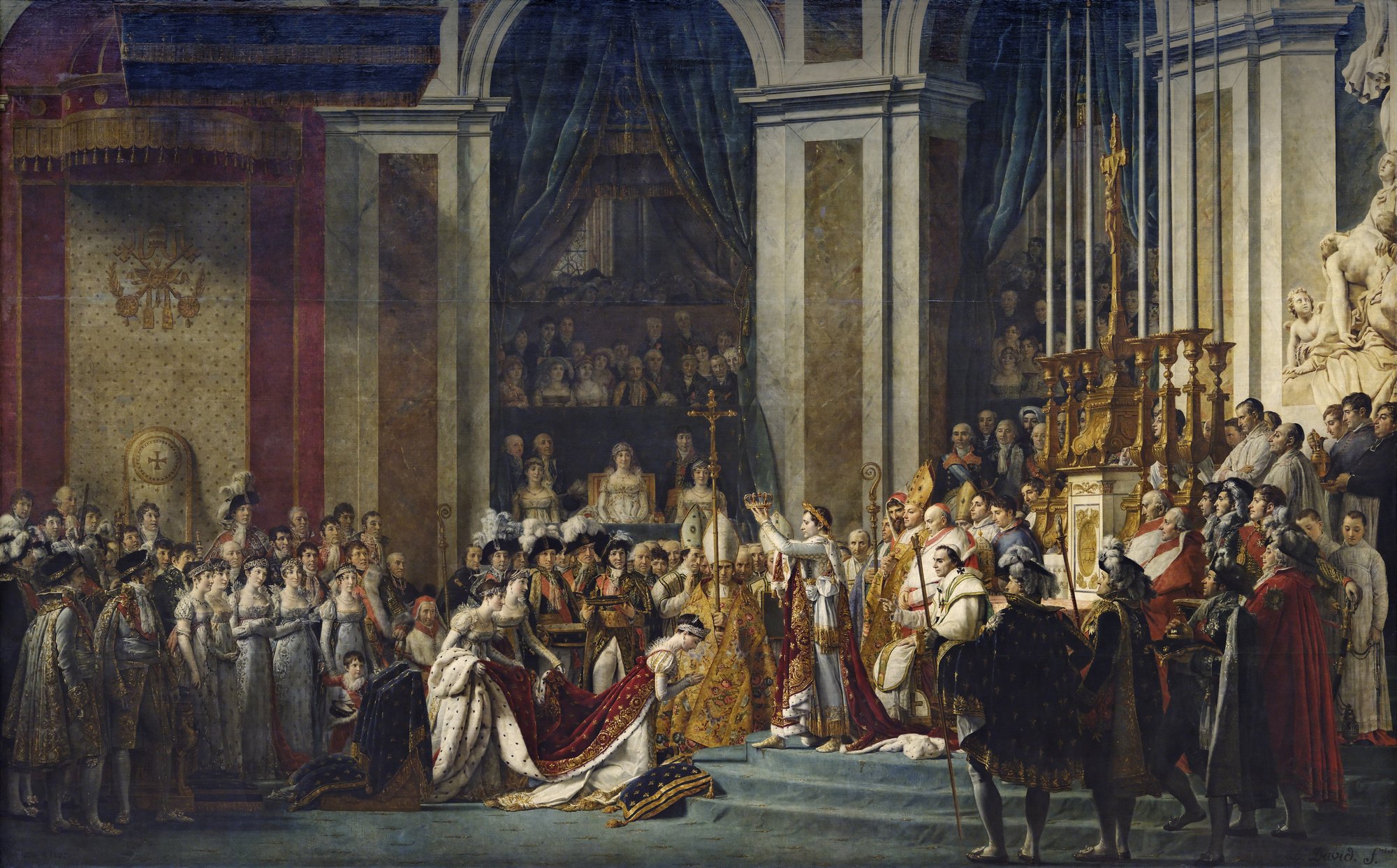
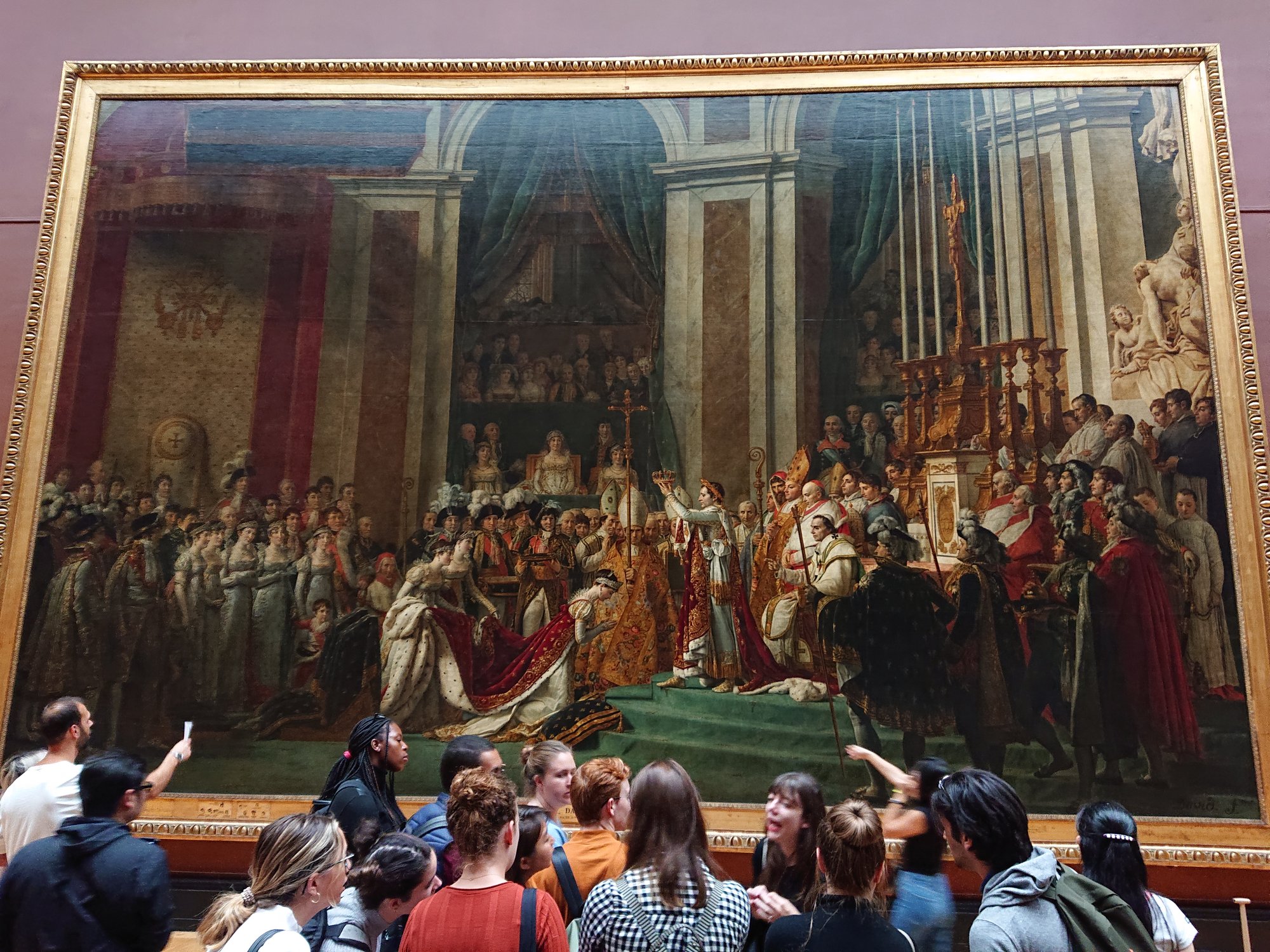
On Sunday, December 2, 1804, inside Notre-Dame de Paris, Napoleon Bonaparte walked up to the altar, took a golden laurel wreath and put it on his own head. The pope had come from Rome for the occasion. He watched. Then Napoleon picked up a second, smaller crown, held it in the air for a few seconds, and lowered it onto the head of his wife, Josephine, who was kneeling on a violet cushion in front of him.
Jacques-Louis David was in the cathedral that morning, drawing. He spent the next three years turning what he saw into The Coronation of Napoleon, the painting known in France as Le Sacre. It is six metres high and almost ten wide, and Côme Fabre, the curator who wrote the Louvre’s current entry for it, counts about 190 figures, 93 of them portraits of real people: 59 men, 33 women and one child. Apart from the Emperor, the Empress and the pope, Fabre writes, most of the people David could identify came to his studio to pose and lent him the clothes they had worn that day. Four people who were not in the cathedral are in it anyway.
The Coronation of Napoleon characters at a glance
Reading the canvas left to right, these are the figures with a name attached:
- Joseph and Louis Bonaparte, far left, in gold-embroidered cloaks. Joseph is the elder, nearer the edge.
- Caroline, Pauline and Elisa Bonaparte, Napoleon’s sisters, side by side in white.
- Hortense de Beauharnais, Josephine’s daughter and Louis’s wife, holding the hand of her son Napoléon-Charles, the only child in the picture. Joseph’s wife Julie Clary stands with the family group.
- Joachim Murat, Napoleon’s brother-in-law, behind Josephine, holding the empty cushion her crown came from.
- Josephine, kneeling, her train carried by her ladies Madame de La Rochefoucauld and Madame de La Valette.
- Letizia Bonaparte, Madame Mère, seated in the box in the middle distance. She was not in the cathedral.
- Jacques-Louis David, sketching in the gallery above her, among his family and fellow artists.
- Napoleon, standing on the altar step with the crown raised.
- A priest with the face of Julius Caesar, just to Napoleon’s right, looking up at him.
- Pope Pius VII, seated, right hand raised in blessing, with Cardinal Caprara behind him and Cardinal Braschi in a gold mitre.
- The foreign ambassadors, in the background to the right, including the Ottoman envoy in a white turban.
- Charles-François Lebrun, Jean-Jacques-Régis de Cambacérès and Louis-Alexandre Berthier, right foreground, carrying the eagle sceptre, the hand of justice and the orb.
- Talleyrand, in the red cloak near the right-hand corner, with Eugène de Beauharnais in hussar uniform above him.
Who is Napoleon crowning, if not himself?
The painting’s popular name is a small lie. It is called the Sacre, the anointing, and it shows neither the anointing nor Napoleon’s own crowning. It shows Josephine’s.
The Louvre is precise about the moment. In the ceremony, Napoleon crowned himself first, then took up the empress’s crown and held it over her. David paints that second gesture. The official description printed when the picture was first shown in 1808 put it this way: the Emperor, “after having himself placed on his brow, one after the other, two crowns,” has just taken up the second again and is about to set it on his wife.
She was forty-one that morning; he was thirty-five. David’s Josephine does not look forty-one.
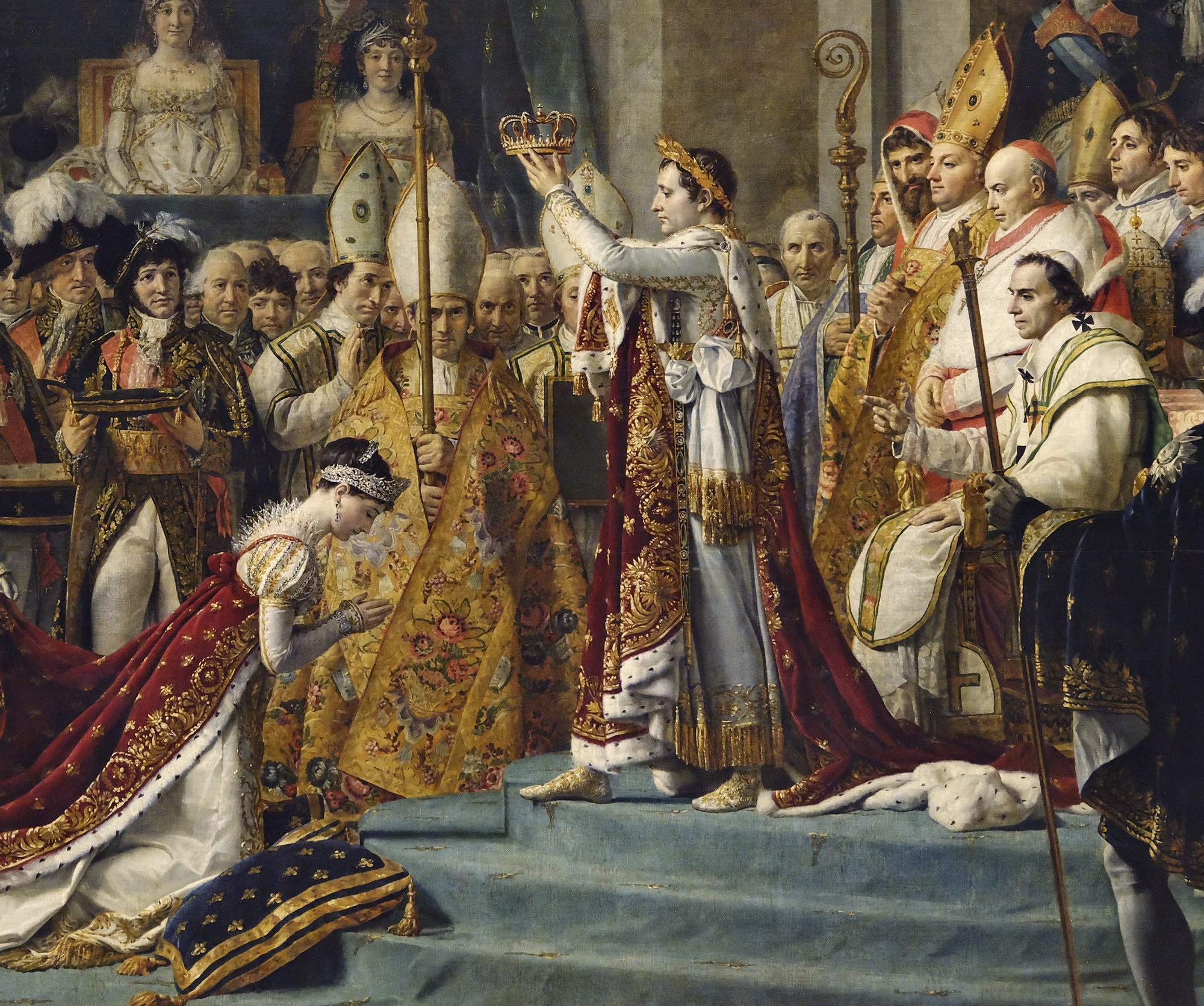
Behind her, in a black hat with white plumes, is Joachim Murat, Napoleon’s brother-in-law and one of his marshals. He is still holding the cushion the crown was carried in on. It is empty now.
The self-crowning David painted, then erased
David did not start with Josephine. Three preparatory sketches survive showing the whole composition, and Sylvain Laveissière, then a curator in the Louvre’s paintings department, writing for the Fondation Napoléon in 2013, notes that all three show the Emperor crowning himself. So does a black-pencil study in the Louvre’s drawings collection: Napoleon holds a crown above his own head with one hand and grips his sword with the other, while the pope sits beside him with his hands lowered, not blessing anything.
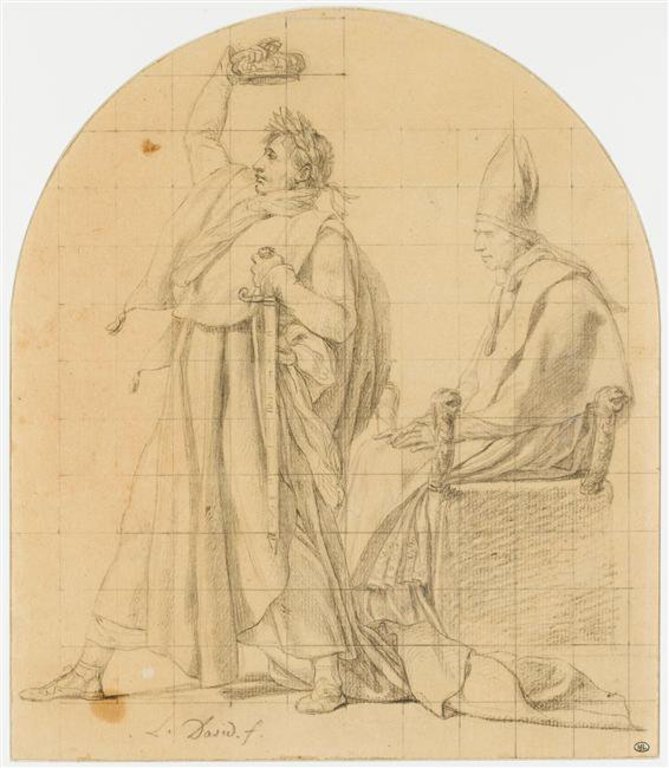
That pose made it onto the canvas. According to Fabre, David painted Napoleon crowning himself, then in August 1806 painted the figure out entirely and repainted him upright, calmer, turned toward his wife. Laveissière credits the suggestion to François Gérard, the court portrait painter, who thought the emperor should be shown crowning his consort. The self-crowning was the more political gesture. The new one was the better picture.
The man with Julius Caesar’s face
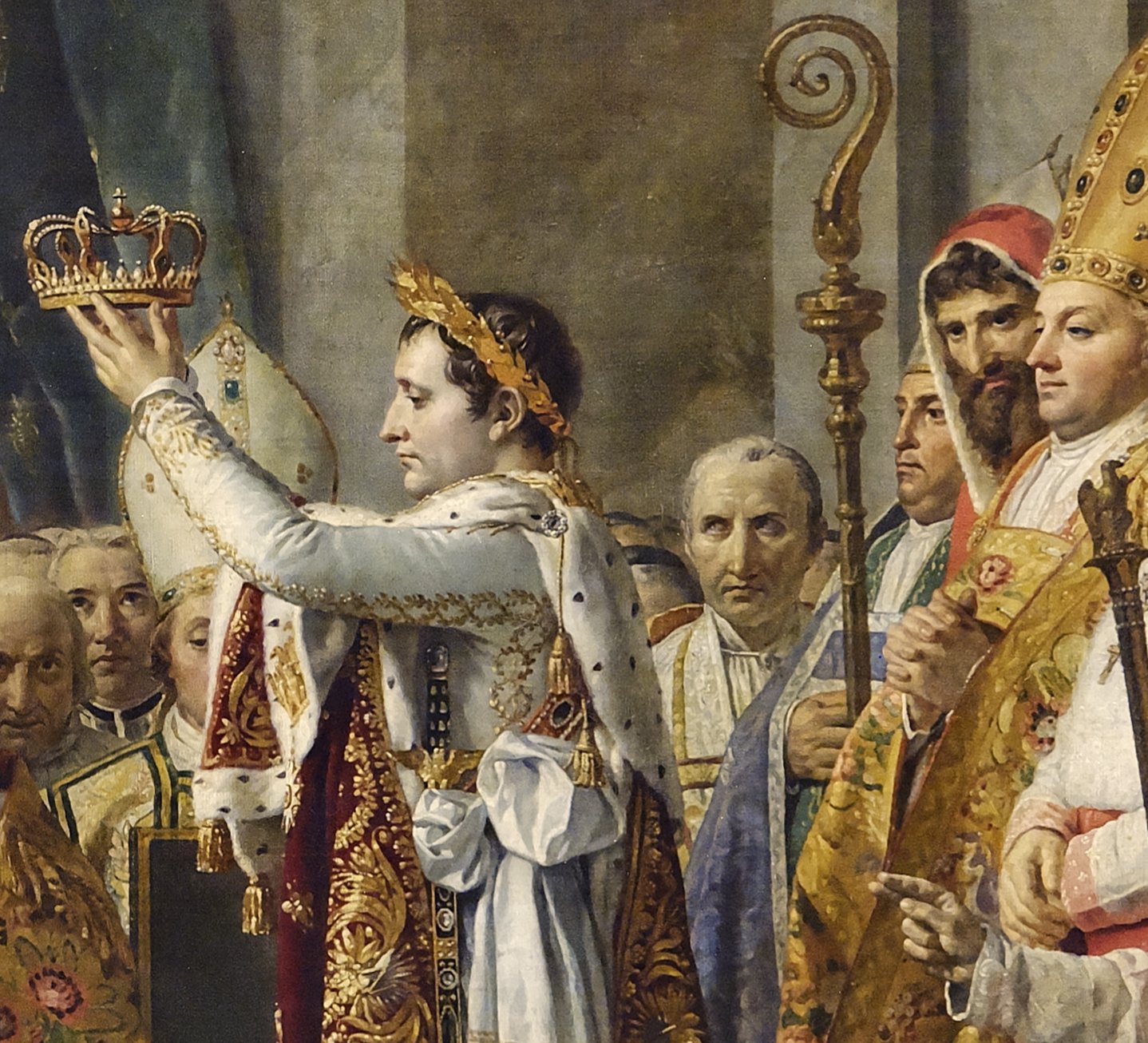
Straightening Napoleon’s back left a small gap beside him, and something had to fill it.
Fabre identifies what David put there. Immediately to Napoleon’s right, one row back, is a priest with a greyish complexion lifting his eyes toward the Emperor. His face is taken from a bust believed to represent Julius Caesar. David added him, Fabre writes, to fill the small space freed when the Emperor’s posture was corrected. It flatters Napoleon with the comparison to Rome’s great general. It also puts, in Fabre’s words, a “sinister omen” at his elbow: Caesar was killed by conspirators who suspected him of wanting to make himself king.
Why is the Pope’s hand raised?
Pius VII sits behind Napoleon, in white, with a white skullcap and a pallium marked with black crosses. His right hand is lifted, two fingers raised, blessing the crown. It is the one thing Napoleon asked David to change.
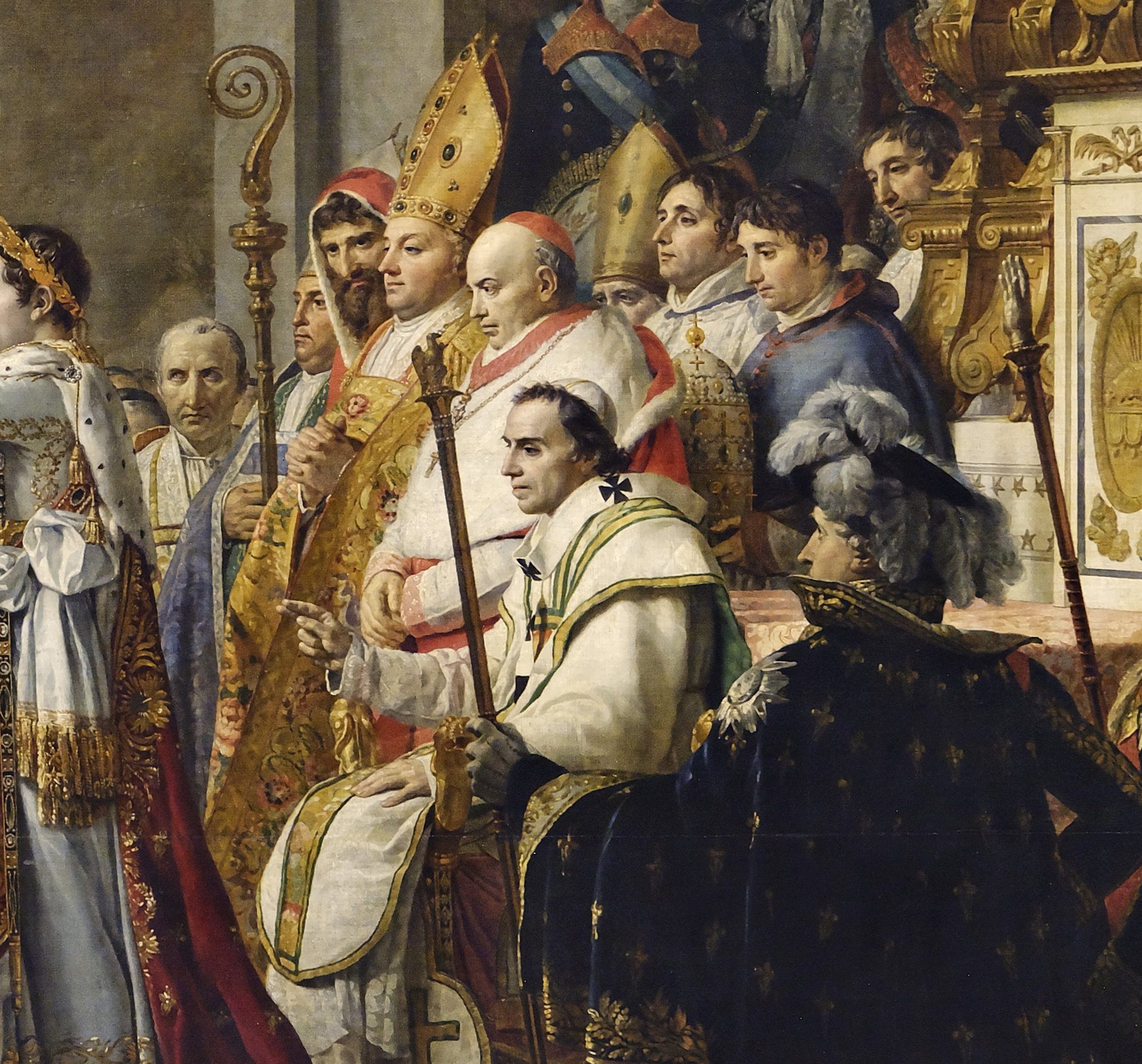
The Louvre’s account is specific. On November 18, 1807, Josephine came to David’s studio to see the almost-finished canvas. On Monday, January 4, 1808, she came back with Napoleon and a group of court officers. The Emperor congratulated the painter and asked for exactly one change: raise the pope’s right arm so that he makes the sign of blessing. Laveissière adds that the blessing was in David’s plans at one point and that David had dropped it; Napoleon had him put it back.
A pope with his hands lowered looks like a guest who has been kept waiting. A pope blessing looks like a partner in the event. Napoleon wanted the partner.
Behind Pius, in a red cap and an ermine-lined cape, is the papal legate, Cardinal Caprara. The 1808 description puts Cardinal Braschi beside him, standing in a gold mitre and cope with his hands joined. Caprara’s presence is one of David’s inventions. Fabre notes that he was ill and missed the ceremony.
Chiaro is built for a detail like that raised hand, which a visitor in Room 702 sees from the middle of the room and never thinks to question: the story of the January 4 studio visit is told while you are looking at the two lifted fingers.
Why is Napoleon’s mother in the painting?
In the middle of the canvas, in a box of her own under the gallery, sits a woman in white with a diadem and a veil, flanked by attendants of her household. She is Letizia Bonaparte, the Emperor’s mother, known at court as Madame Mère. David gave her the best seat in the building.
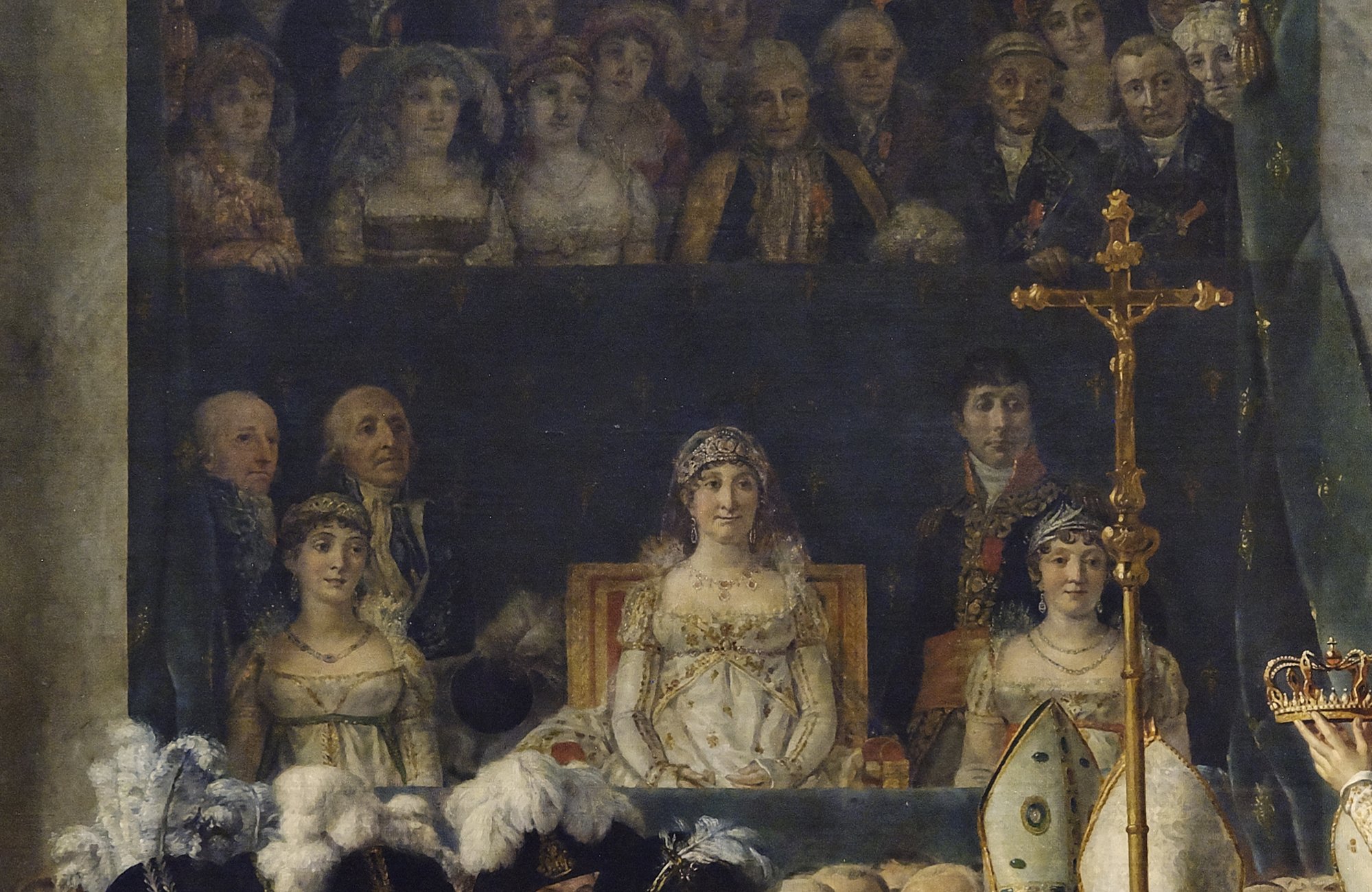
She was in Rome. Laveissière describes her as famously absent from a ceremony she disapproved of, and says Napoleon demanded she be painted in. Fabre lists four people in the picture who were not in the cathedral: Madame Mère; Cardinal Caprara, who was sick; and the ambassadors of the Ottoman Sultan and of the Holy Roman Emperor. All four were added, the Louvre says, at the Emperor’s request.
The curators at Versailles point out that two of Napoleon’s brothers, Lucien and Jérôme, did not come to the coronation either, and David did not paint them in.
Coronation of Napoleon painting figures, left to right
Start at the left edge, where Fabre says David put the imperial family. Two men in cloaks stiff with gold embroidery stand in profile. The Versailles curators identify them as Joseph Bonaparte, the eldest brother, nearest the edge, and Louis, the brother who married Hortense de Beauharnais.
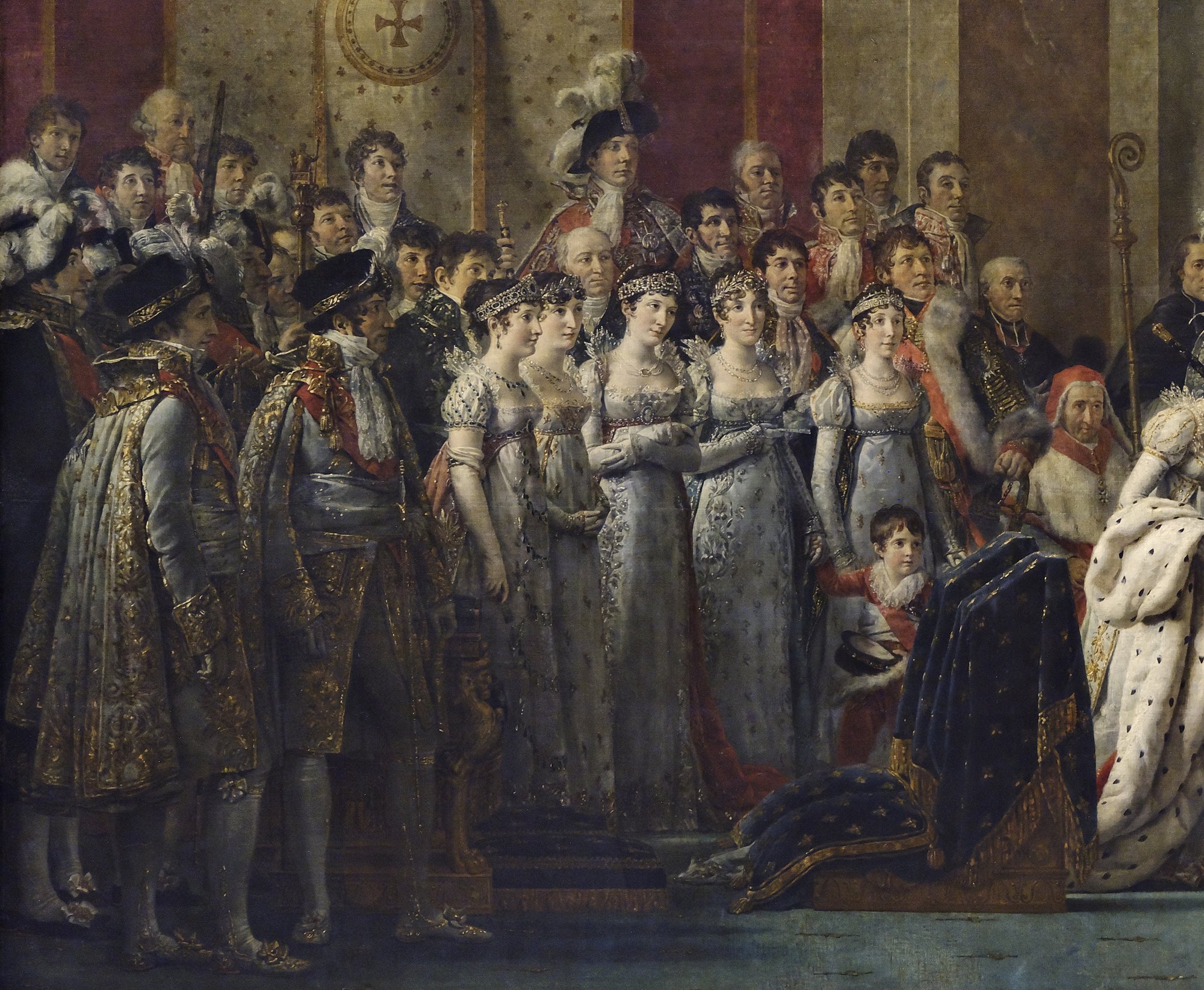
Next come the women in white. The first three are Napoleon’s sisters: Caroline, married to Murat and later Queen of Naples; Pauline, the one who stayed loyal to her brother as far as Elba; and Elisa. Hortense de Beauharnais, Josephine’s daughter, holds the hand of a small boy in red. He is her son Napoléon-Charles, the one child among Fabre’s 93 portraits. Joseph’s wife, Julie Clary, stands in the same group. Behind them rise the plumed hats of the marshals, the army standing a step back from the family.
The boy never saw the finished picture. Napoléon-Charles died of croup in The Hague on May 5, 1807, at four years old. David kept painting until the middle of November.
The men carrying the regalia
The right foreground belongs to the men who ran the Empire. The 1808 description names them in order. Charles-François Lebrun, the arch-treasurer, has his back to us, in a Henri IV hat and violet mantle, holding a staff topped with the imperial eagle. Beside him, in profile, Cambacérès, the arch-chancellor, holds the hand of justice, a sceptre that ends in a small carved hand. Then Berthier, carrying the orb and cross on a cushion.
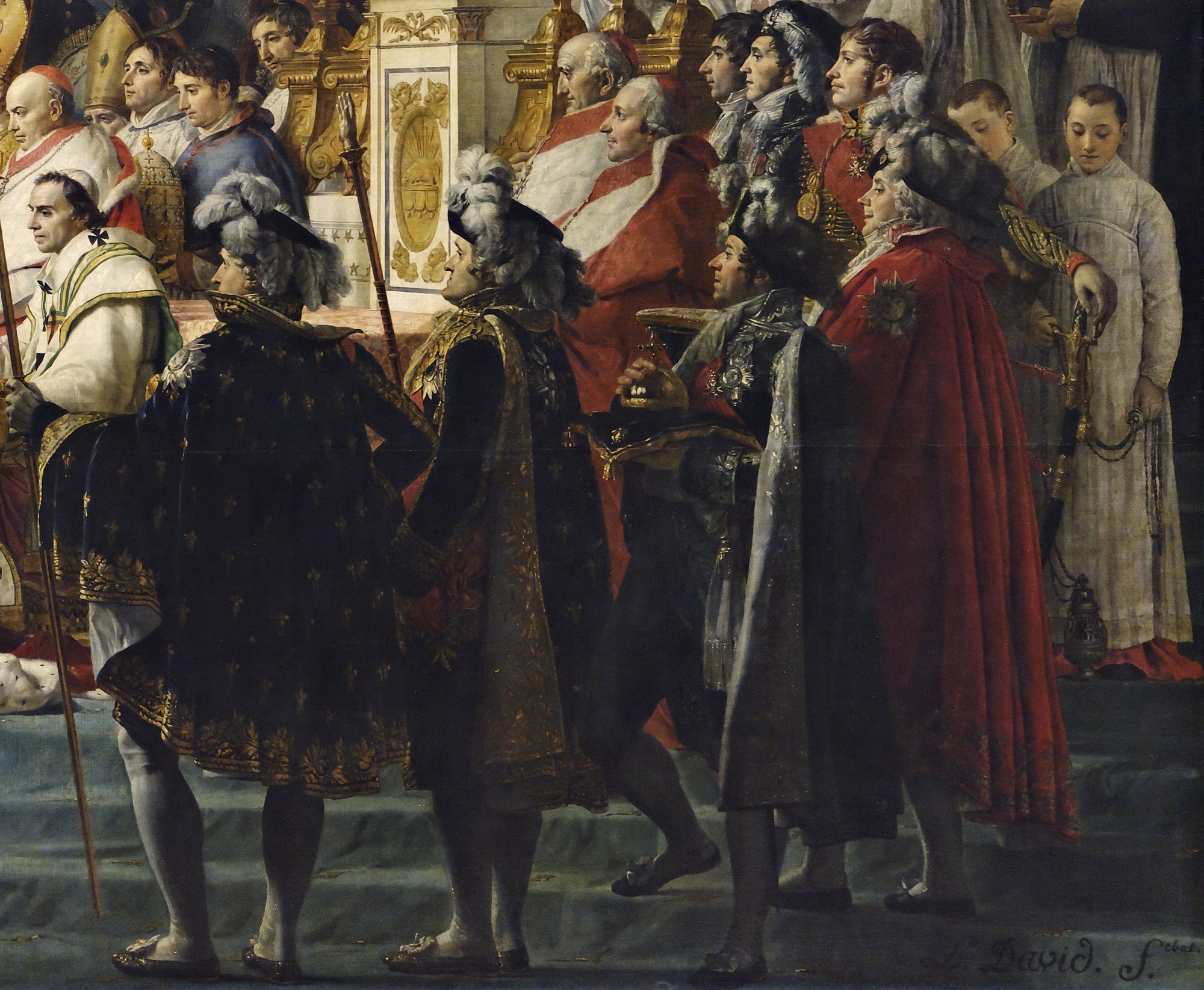
Almost at the corner, in a red cloak, is Charles-Maurice de Talleyrand, the grand chamberlain, who would go on to serve the Bourbons after Napoleon fell. Above his head, bareheaded in hussar uniform with his hand on his sabre, is Eugène de Beauharnais, Josephine’s son. His sabre hangs just in front of the choirboy with the censer.
The ambassador who wasn’t there
Fabre places the foreign ambassadors at the back on the right. The easiest one to spot is the man in the white turban.
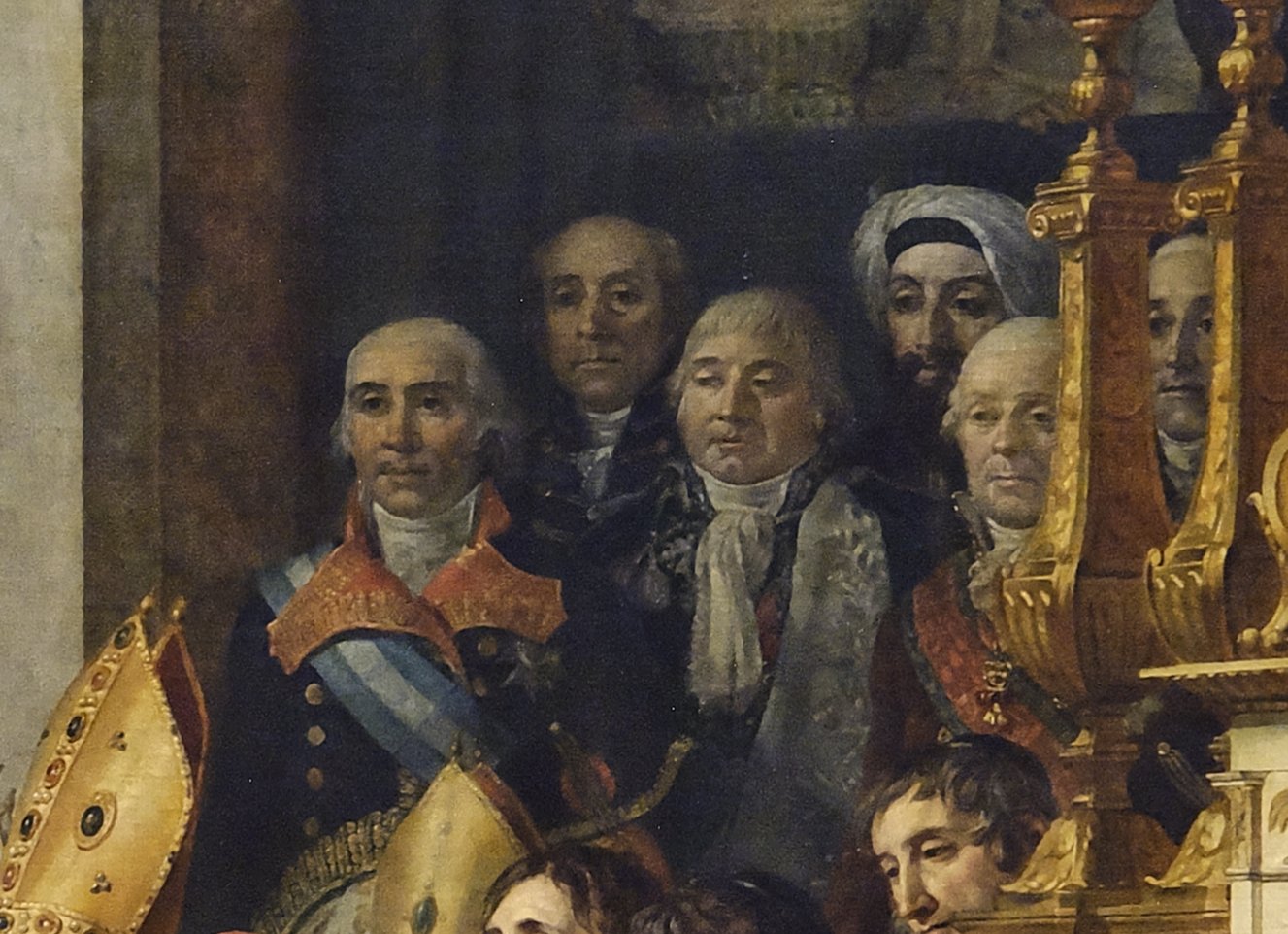
He represents the Ottoman Sultan, and according to Fabre he is one of the four people in the painting who were not in Notre-Dame. The Holy Roman Emperor’s ambassador was not there either. David put both of them in. A coronation looks more legitimate when Constantinople and Vienna appear to be watching.
Where is David in The Coronation of Napoleon?
Look above Madame Mère’s box, into the gallery hung with green curtains. David painted himself there, drawing, surrounded by his wife and their twin daughters, his assistant Georges Rouget, and his friends among the artists and academicians. The Versailles curators read it as a symbol of the study the painting cost him.
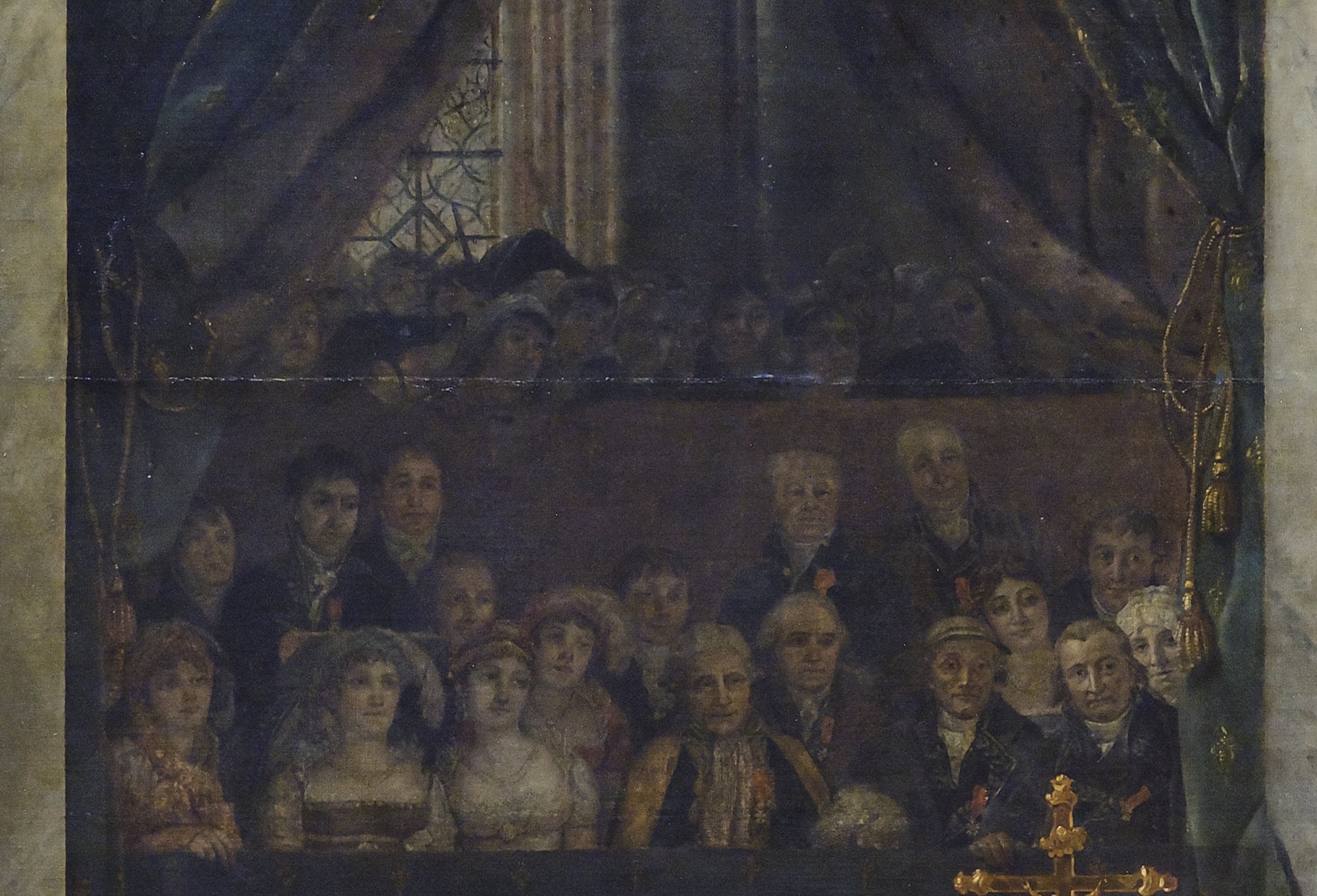
The gallery is darker than the rest of the canvas and hard to read from the floor. The Versailles curators, in the game sheet they hand to visitors, give the clue as “He is sketching the scene from a gallery above, beneath great curtains.” Rouget did more than sit for it. Fabre credits him with most of the costumes and accessories, and credits the theatre designer Ignazio Degotti with the architecture and perspective. David worked in a disused Gothic chapel on the place de la Sorbonne, planning the crowd with a three-dimensional model and small dressed dolls.
He also changed the cathedral. At the time, Notre-Dame’s Gothic choir was hidden behind classical arcades, and David simplified the carpets, turned the red hangings green and invented the big green curtains. One thing he kept: at the far right edge, above the altar, is Nicolas Coustou’s marble Pietà, finished in 1723. Fabre notes it is still in place. You can see it today in Notre-Dame, which reopened after the 2019 fire, and our Notre-Dame guide covers the rest of the building.
Are there two Coronation of Napoleon paintings?
Yes. The one in the Louvre is the original. The second is at Versailles, in the Coronation Room, and it has a stranger history than the first.
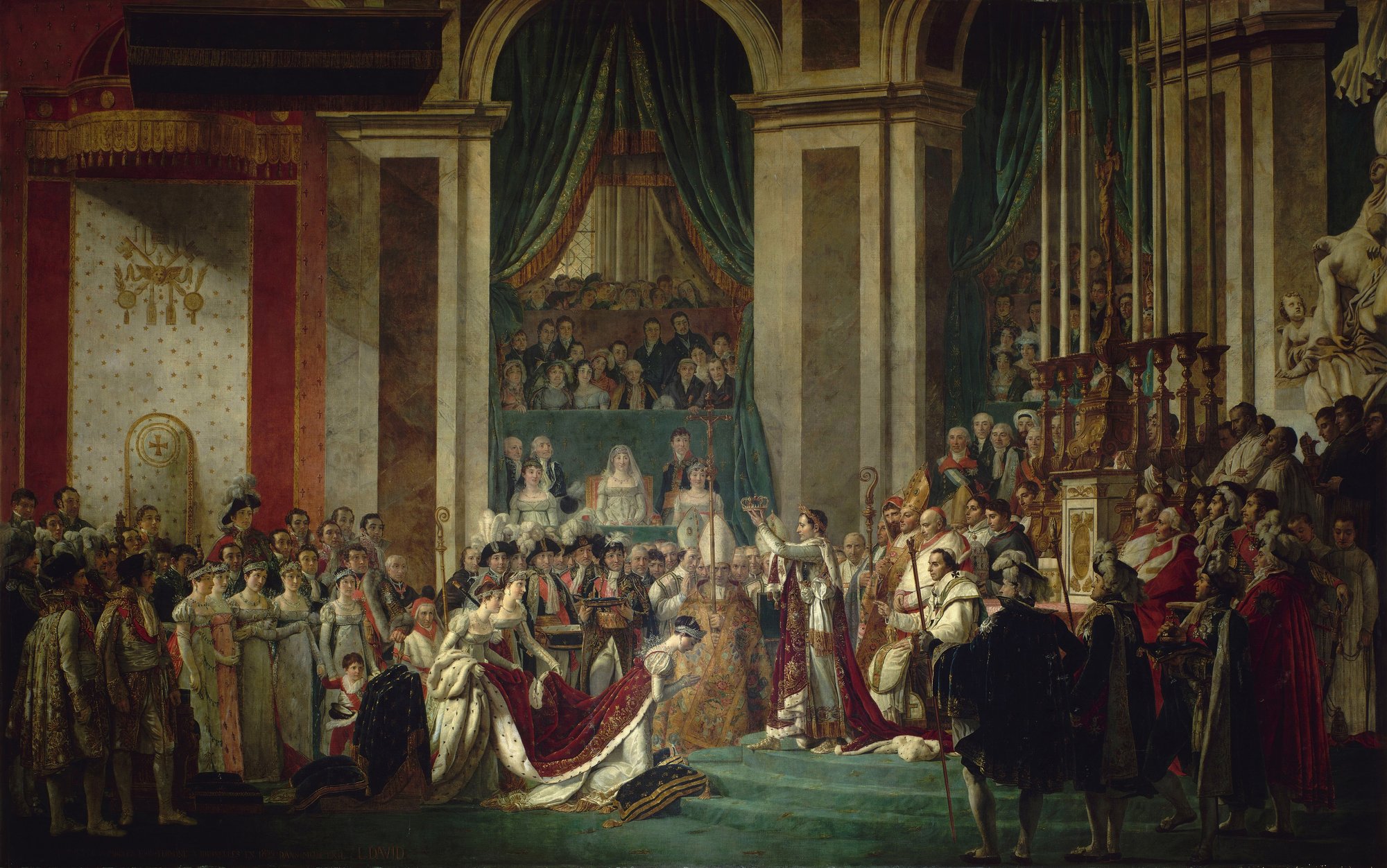
The Palace of Versailles says David painted it in Paris and then in Brussels, between 1808 and 1822, for a group of American businessmen. It was shown across the United States and Europe through the nineteenth century. Versailles bought it in 1947 and hung it in the Coronation Room the following year, in the space where the original had hung from 1837 until it went to the Louvre in 1889. Our Versailles guide has the rest of the palace.
The easiest difference to find is on the left. In the Versailles version, the second of the three sisters wears pink.
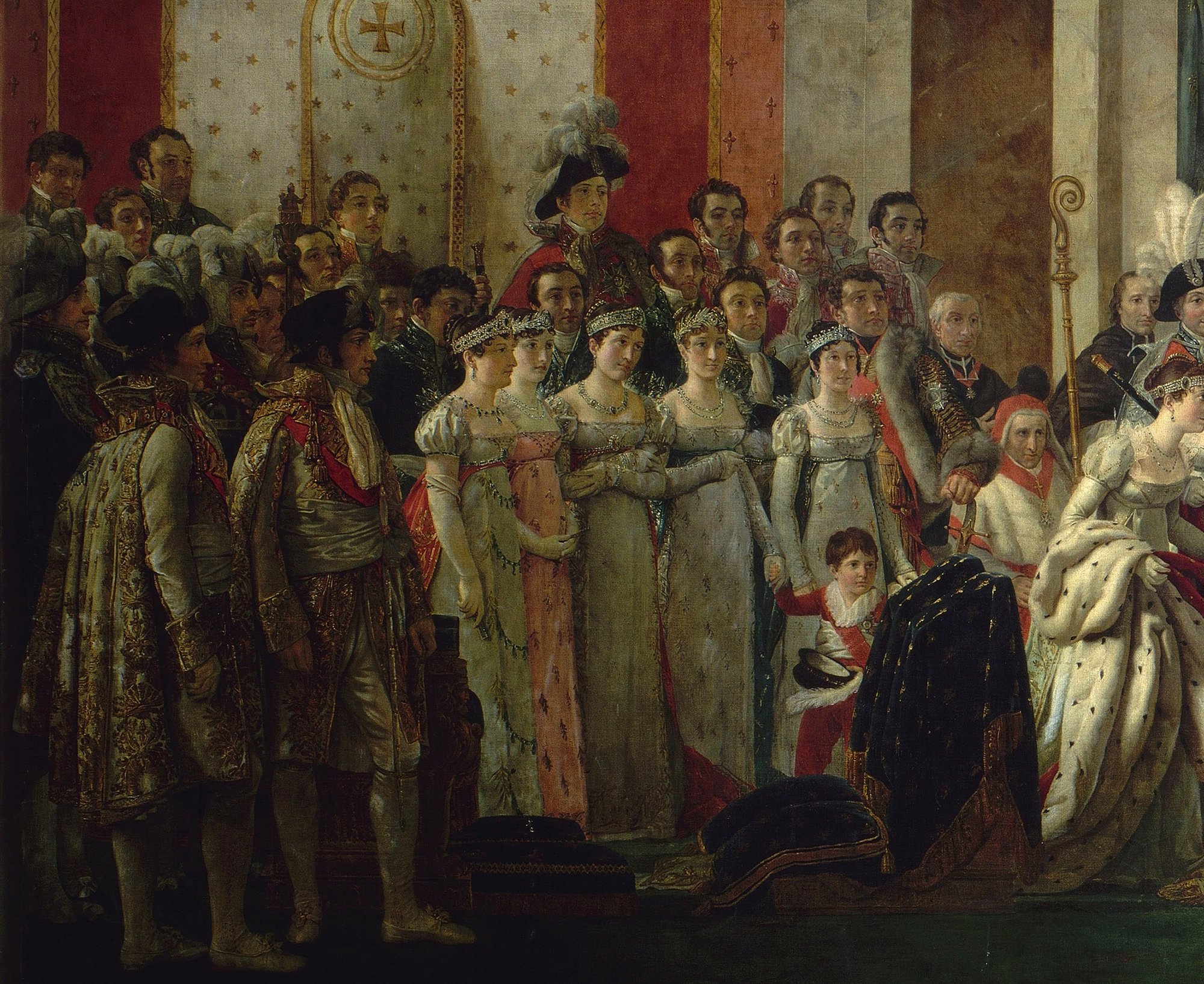
Versailles identifies her as Pauline Borghese, the sister the palace describes as the only one of the three who stayed close to Napoleon. In the Louvre original her dress is white like the others’. David finished the replica in Brussels as an exile. By then Napoleon had been dead for a year.
Which room is it in at the Louvre?
The Coronation hangs in the Louvre’s Denon wing, level 1, in Room 702, the Salle Daru, one of the red rooms given over to large French paintings. The museum’s own record says it has hung there since 1994. It is oil on canvas, 6.21 metres high and 9.79 metres wide, and David signed it at the bottom right and dated it 1806 and 1807 at the bottom left.
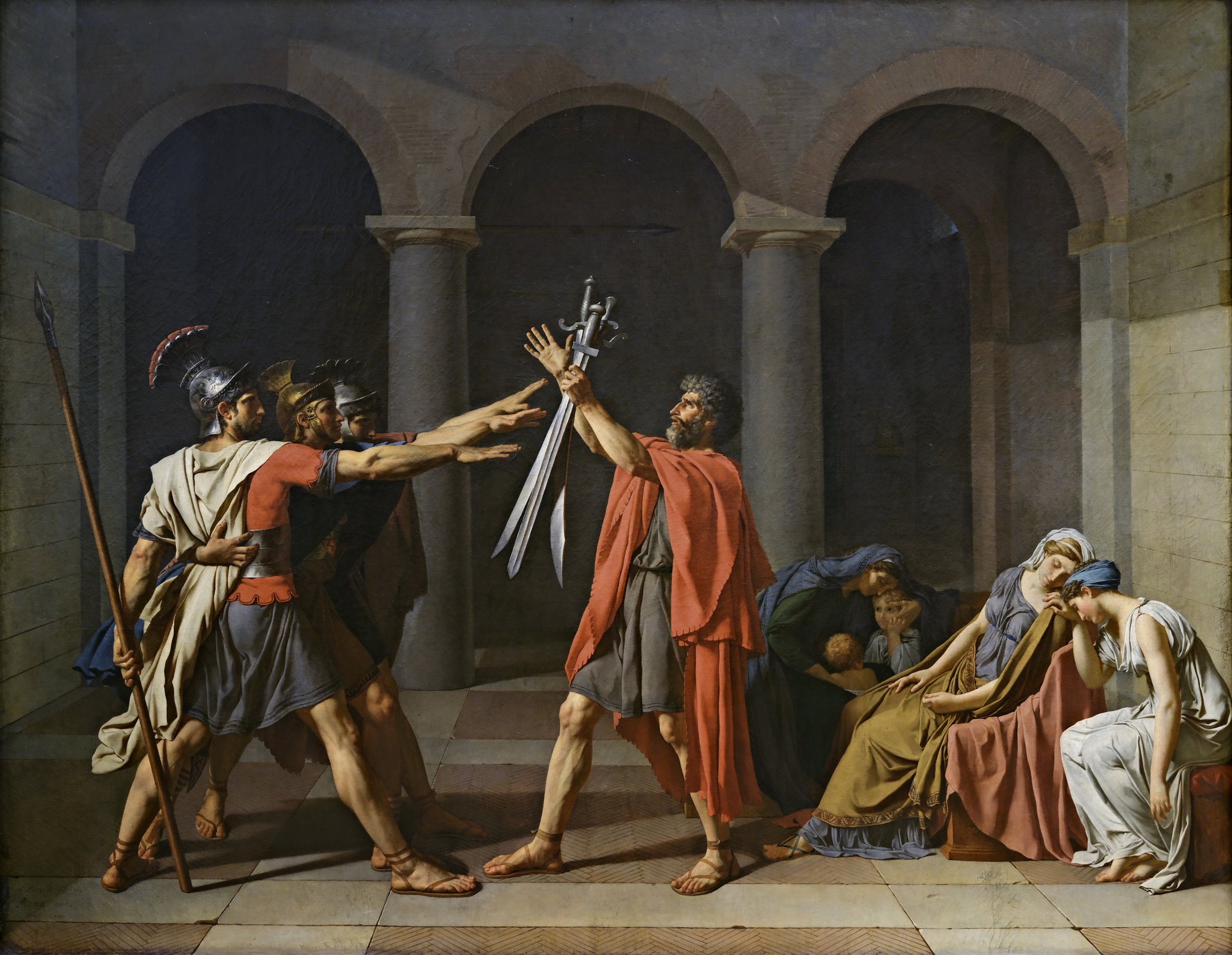
In the same room is the painting that made David famous twenty years earlier, The Oath of the Horatii. The Louvre’s record says it was painted in Rome and finished in July 1785. It is roughly a quarter the size of the Coronation and says more with a father and three sons than the later picture says with 190 people.
The Louvre’s site gives its hours as 9 a.m. to 6 p.m. on Monday, Thursday, Saturday and Sunday, and 9 a.m. to 9 p.m. on Wednesday and Friday. It is closed on Tuesdays. Tickets are 22 euros for residents of the European Economic Area and 32 euros for everyone else. If you are already on this floor for the Mona Lisa, Veronese’s Wedding at Cana, which is bigger still, is in the same wing. Our guides to what to see at the Louvre and to the Louvre’s paintings cover what else is close by.
What to look for when you stand in front of it
Stand back far enough to take in the whole thing first, which in the Salle Daru means the middle of the room. Then walk in and work through it the way David arranged it.
Find the empty cushion in Murat’s hands. Find the pope’s two raised fingers and remember they were painted in after January 4, 1808. Find the grey-faced priest just behind Napoleon’s shoulder, the one looking up, and remember whose face he has. Then look up, past Madame Mère in her box, into the dark gallery with the green curtains.
David wanted 100,000 francs for the painting. The Louvre’s record says he got 65,000, after a negotiation that ran until February 1810 with Count Daru, the intendant-general of the Emperor’s household. The room the painting hangs in today is the Salle Daru.