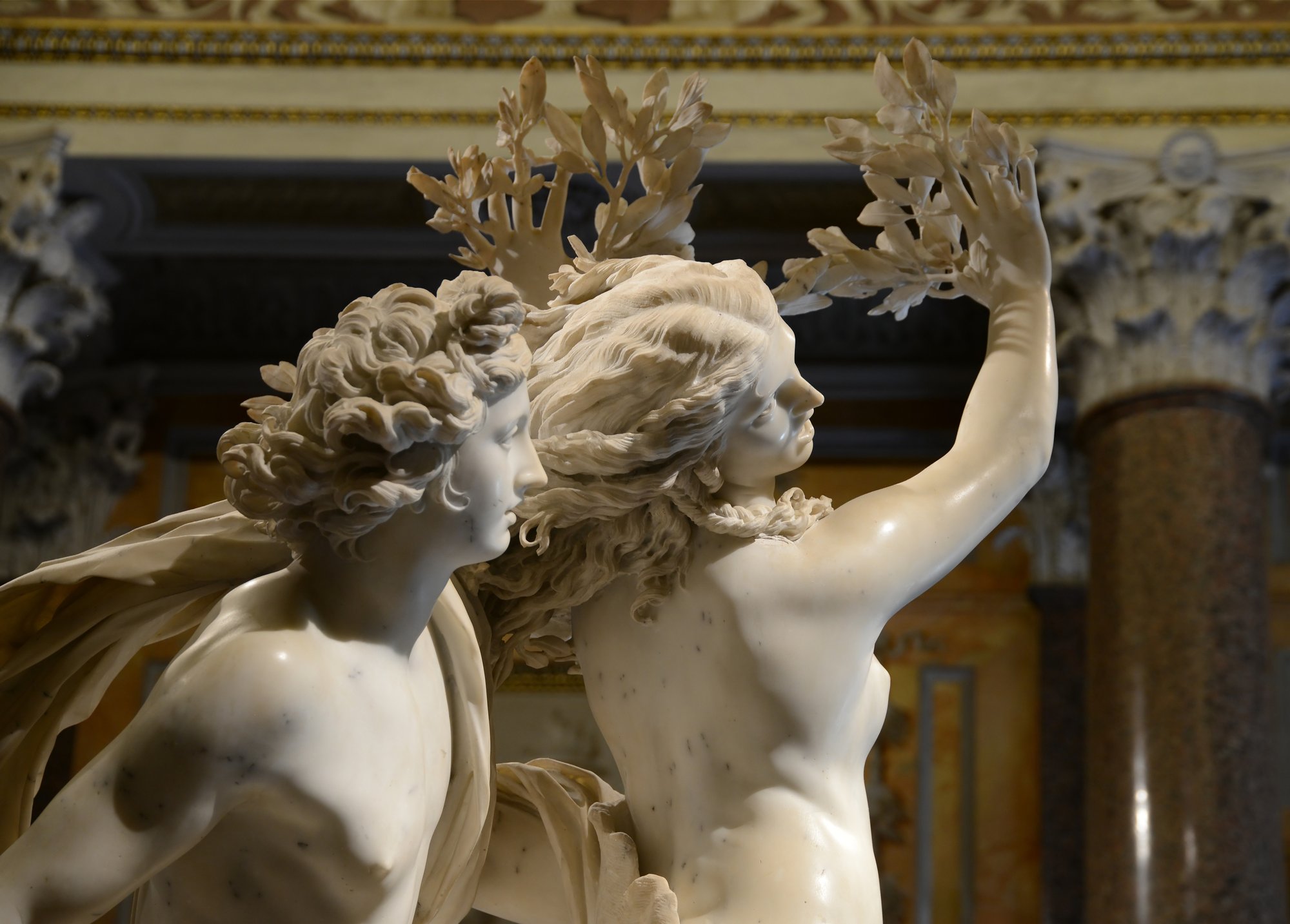
The Apollo and Daphne Bernini carved for Cardinal Scipione Borghese is the reason people go quiet in room three of the Galleria Borghese. Walk to the back of it. Most people don’t. Most people stop in front, where the story is legible. Apollo reaches. Daphne screams. Her fingers have already become branches. But the back is where you learn something. Back there, at the level of her outstretched left hand, you can see the leaves. They are under two millimeters thick. Some of them are so fine that light passes through the edges and turns them the color of weak tea. One of the restorers who worked on the sculpture in 2002 told a journalist that if you flick them very lightly with a fingernail, they ring. Not a thud. A clear, short note. Like a glass.
The piece was finished in 1625 by a man who was twenty-four years old.
Why Apollo and Daphne Bernini still empties a room
Every room in the Galleria Borghese has a centerpiece. This one has a piece of marble you think cannot be marble. That is the whole effect. The Carrara block Gian Lorenzo Bernini started with was about three meters high and weighed somewhere around four tons. What he made from it is a two-figure running composition with an extended left arm, an extended right arm, a twisting torso, a pursuing male nude, leaves, a trailing root, and all of it balanced on one small patch of rock and one carved tree trunk. Structurally, it should have fallen over. The leaves alone should have snapped off during carving. They didn’t. They haven’t in four hundred years.
Most sculptors, working from stone this thin, thread a metal armature through the piece and hide it. Bernini didn’t. What you are looking at is unreinforced marble stretched to the edge of what marble can do. The leaves on Daphne’s hand are the thinnest carved stone in western sculpture that hasn’t broken. That is the reason this room is usually quiet. People see it and forget what they were about to say.
The commission, and the cardinal who wanted blood
The commission came from Cardinal Scipione Borghese. He had already bought the young sculptor on retainer. Bernini had finished The Rape of Proserpina for him in 1622, and Scipione wanted another. The subject was his father’s idea, probably: Ovid’s Metamorphoses, book one. Apollo, drunk on his own skill after killing the Python, mocks Cupid for playing with a bow. Cupid shoots him with a gold arrow, making him love Daphne, and shoots Daphne with a lead one, making her hate him. Apollo chases. Daphne prays to her father, the river god Peneus. Peneus turns her into a laurel tree just as Apollo’s hand reaches her hip.
The last half-second of the chase is what got carved. Apollo’s left hand has just touched Daphne’s waist. His fingers are pressing into her flesh. Under his fingertips, her skin is rippling and puckering, because it is already turning to bark. If you look at the exact point of contact and then follow her body up, you can watch the transformation happen in real time: thigh is still skin, waist is skin turning rough, ribs are half-bark, the shoulder is splitting into branches, and the hair is leaves. Her mouth is still open from the scream. Her toes have rooted. A slender trunk has come up between her ankles and swallowed one of her feet.
All of this was carved. The word “carved” does a lot of hiding. Four hundred hours, five hundred, nobody knows exactly, of a young man standing in a workshop with chisels and a bow drill and working a single block backwards out of itself, removing everything that wasn’t the sculpture. And he signed the finished piece on the pedestal.
The sightlines are calibrated like architecture
Here is what almost no guide mentions. The piece is designed to be walked around, and Bernini calibrated the sightlines with something close to architectural precision. Stand where the visitors usually stand, in front, and it is a narrative: pursuit and rescue. Walk clockwise around it, and the story changes meaning every quarter turn. From the left, you see only Apollo pursuing, his cloak flying. The transformation is hidden. From the back, you see only Daphne changing, her bark spreading up her back, and Apollo’s face has fallen into shadow. From the right, you see Apollo realizing what is happening. His expression shifts. His hand is still touching her, but he is already starting to pull away.
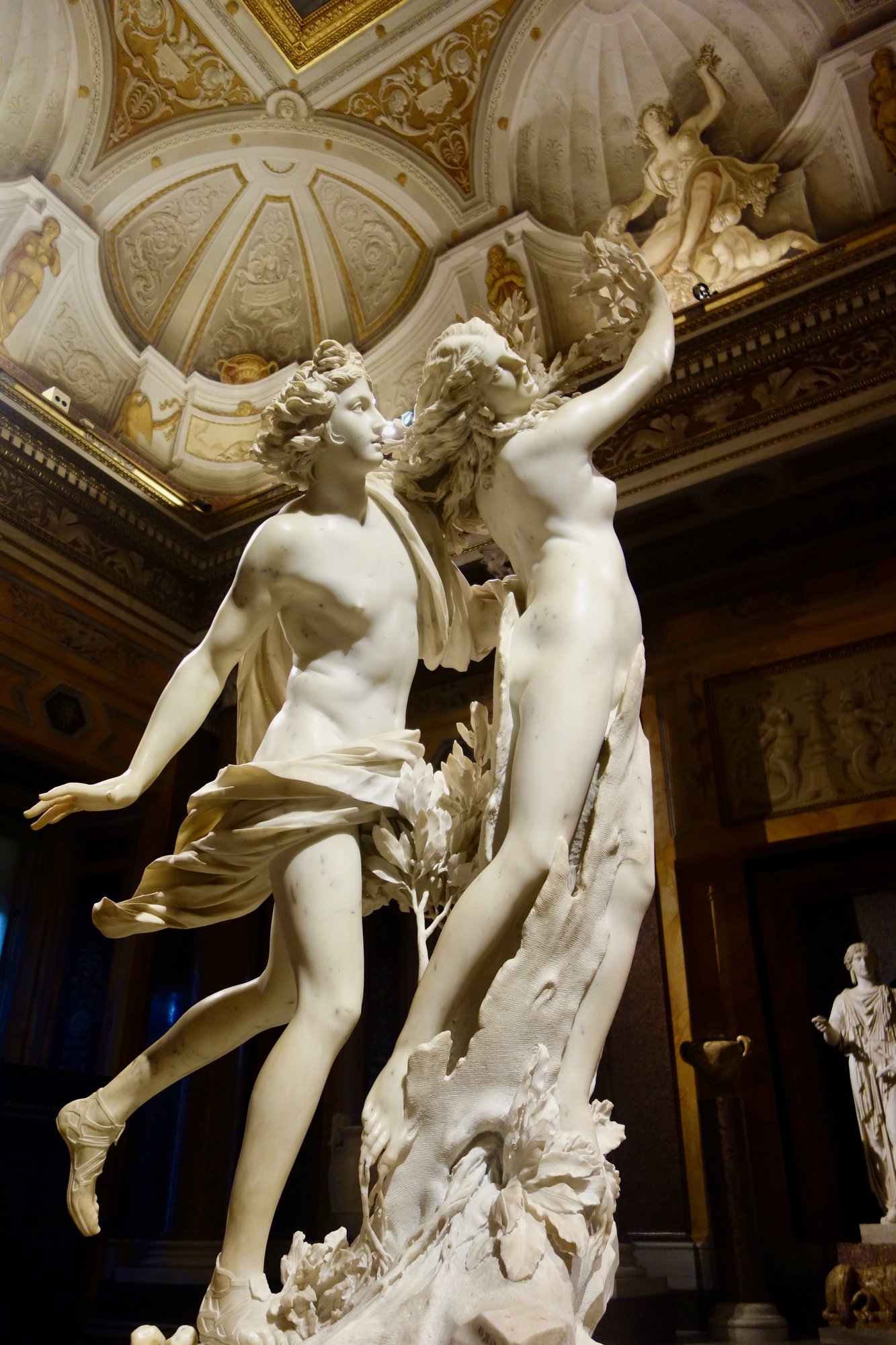
The original installation in Scipione’s villa put the piece against a wall, so the cardinal’s guests would see it face-on as a classical scene. Bernini built the composition so the frontal view was the respectable one. The other three views were for the people Scipione wanted to impress: cardinals, visiting ambassadors, the pope’s nephews and cousins, people who would walk around it and realize that what they were looking at was no longer a myth but a physical transformation that kept happening as they moved. The sculpture was reframed in the 1780s so it could be seen from all sides, which is how it sits now in Room Three. That was the right decision. You can feel the piece unfolding as you circle.
Apollo’s cloak and the running-figure problem
The second quiet miracle of the piece is Apollo’s cloak. Running figures are a classical subject, but running figures have a drapery problem. Marble is stone. Stone does not flutter. Every ancient sculptor solved this by making the drapery stick to the body or pool heavily at the ground. Bernini solved it by making Apollo’s cloak fly out behind him, attached to the pedestal by a single thin lip of stone.
Look at it. The cloak is carved in a curl, a frozen ripple, and it is floating in the air behind his left shoulder. There is no visible support. The physics are wrong. You stare at it and you cannot see how it is not falling off. The actual support is a slender bridge of marble running from the back of the cloak to Apollo’s calf. It is almost invisible from the front. It does the load-bearing work. A few millimeters of stone are holding up a kilogram of marble drapery at a running angle. Four hundred years and no crack.
The laurel, the pope, and the censor
Scipione Borghese was a cardinal. His uncle, Pope Paul V, had died in 1621, and the new pope, Urban VIII, who loved Bernini, was watching how Scipione displayed sacred and secular art. A life-size nude Apollo chasing a nude Daphne across a cardinal’s villa was, in the 1620s, close to the line. Another cardinal, Maffeo Barberini, later Urban VIII himself, wrote a Latin couplet for the pedestal to defang it. Roughly: “Whoever chases fleeting pleasure ends with a handful of leaves and bitter fruit.” It was a moral reading of a pagan scene, grafted onto the piece so the sculpture could live in a Christian household.
The couplet is carved on the base of the marble statue. You can still read it. It is Barberini’s way of giving a cardinal cover. The warning is the opposite of what the piece is actually about. The sculpture is about desire in the half-second before it fails, carved by a man young enough to know what that feels like and skilled enough to make the failure beautiful.
What to look for in front of it
Three things, in order.
First, stand in front of Apollo. Find his fingers on Daphne’s waist. Look at the dimpling of her flesh where his fingertips press in. That is marble pretending to be skin. Bernini did this by polishing the contact points with pumice and then with straw for days. The Apollo and Daphne marble is physically the same stone as her bark a few inches higher, but it reads as soft.
Second, walk around to the left. Stop behind her outstretched hand. Get close. Look at the leaves. Count how many there are. Each one is separately carved. Each one has a stem. Some have veins. None of them are broken.
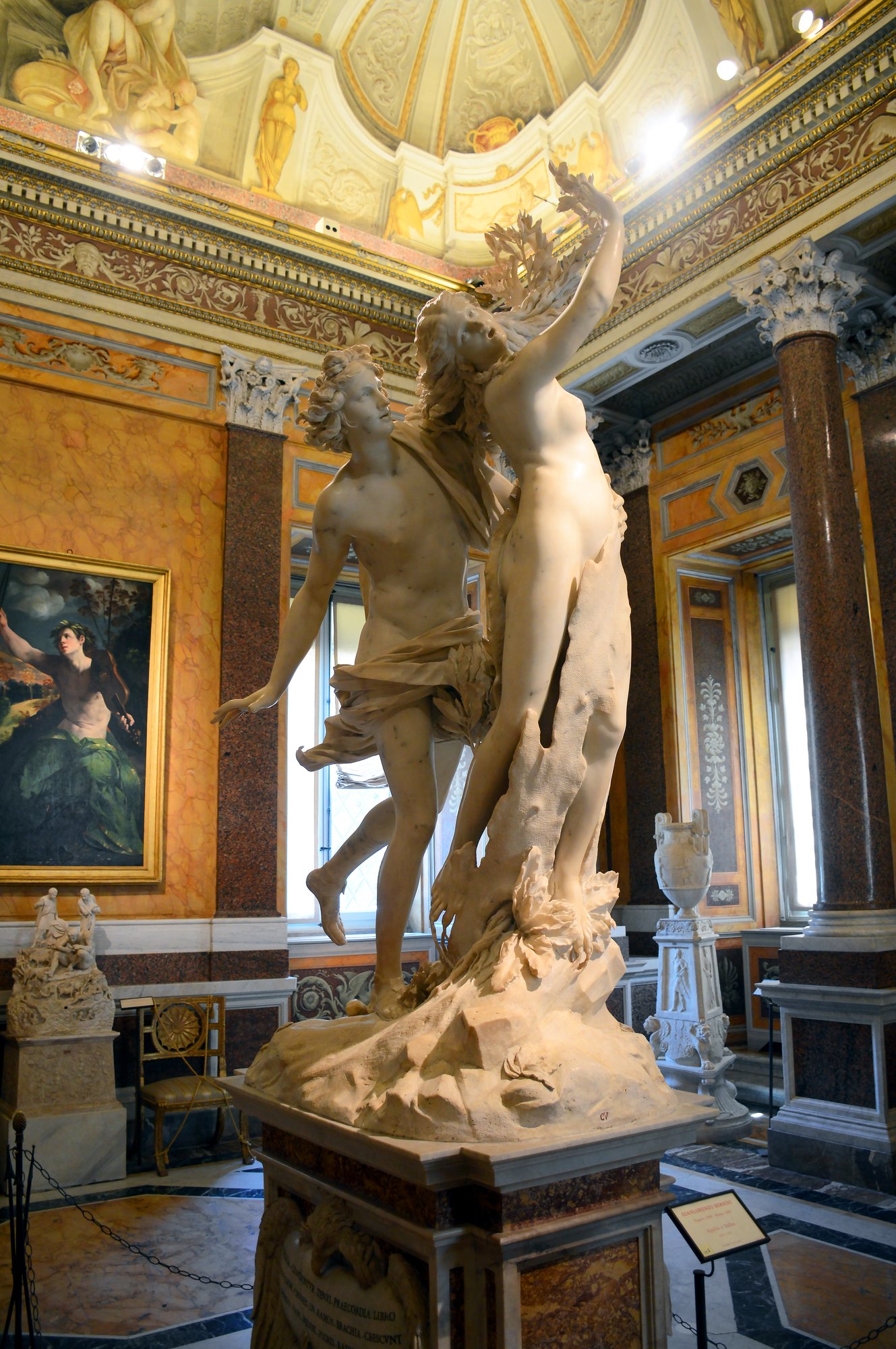
Third, step back and watch someone else walk around the sculpture. Watch their face. They stop when they see Daphne changing. Everyone does. That pause is the point. The piece was built to stop people at the same moment it stopped Scipione’s dinner guests in 1625. Chiaro uses that pause; the Ovid lines run in your ear at the same angle a 1625 guest would have heard Maffeo Barberini’s Latin couplet.
Apollo and Daphne 1622 and the real timeline
You will read in a lot of places that the Apollo and Daphne sculpture was made in 1622. It wasn’t. The commission was signed in August 1622. Bernini was working on it between other jobs, including his David and the conclusion of The Rape of Proserpina, for the next three years. The final delivery to Scipione was in the autumn of 1625. He was twenty-four when he set down the last chisel.
That fact is load-bearing. The leaves on Daphne’s hand, the cloak bridge, the expression on Apollo’s face the moment he realizes he has lost, the bark creeping up her ribs. A twenty-four-year-old carved all of that. Think of every twenty-four-year-old you know. Bernini at that age had already made this.
The leaves and how they survived
The leaves are the question everyone asks and nobody fully answers. The technique, as far as we can reconstruct it, was a bow drill and a series of progressively finer chisels. A bow drill is a tool from the Bronze Age. You bow it back and forth and it spins a small bit, which grinds out stone at a controlled angle. Bernini used the bow drill to hollow out the spaces between leaf clusters, then finer and finer chisels to thin the leaves down to translucence. The last stage was abrasive polishing with pumice and leather. A single wrong tap at that thickness and the leaf breaks. You start over on a new leaf. There is no repair. The thinness is a record of what didn’t fail.
A restoration team went over the piece between 1999 and 2002 and documented every bernini daphne leaves cluster under microscope. A few have hairline cracks. None had to be replaced. The marble itself is from the Carrara quarries in Tuscany, the same quarries Michelangelo used, chosen for a crystalline structure fine enough that it doesn’t fracture along predictable grain lines. The stone is cooperating. But only because Bernini read it correctly.
The transformation on Apollo’s face
Apollo is also transforming. Not physically, but emotionally. If you study his face in detail, you will see that his mouth is closed and his eyes are tracking down his own arm toward where his hand touches Daphne. He is watching the moment happen. His brow is not triumphant. It is starting to crease. Bernini caught him in the half-second between catching her and realizing he has not caught her. He has caught a tree. That is the reading the piece rewards. Pursuit has become loss, and the hunter’s face has not finished understanding yet.
That is what a twenty-four-year-old saw in the story. Not the chase. The moment after.
Kicker
Leaves that ring like a glass. A cloak held up by a sliver of stone. A twenty-four-year-old who figured out how to make marble forget it was marble. A full walk around the piece is the only visit that does it justice.

.jpg)
