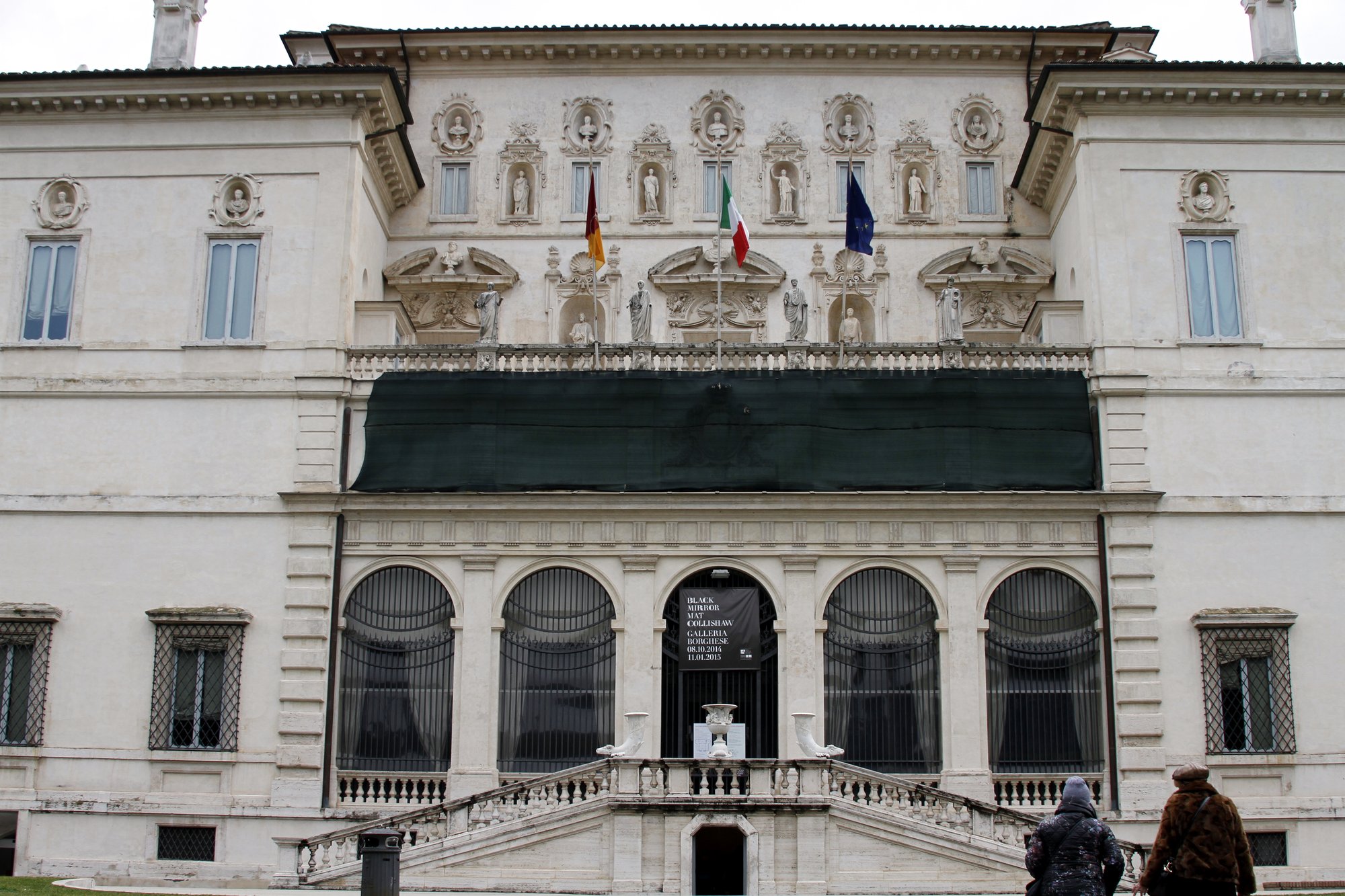
The story of the Galleria Borghese starts on a September morning in 1605, when a fifty-three-year-old Tuscan named Camillo Borghese became Pope Paul V. Nine days later he made his twenty-eight-year-old nephew, Scipione Caffarelli, a cardinal. Two months after that, Scipione took the family name and, with it, access to the Vatican treasury. Within a year he had commissioned a villa on the Pincian Hill, north of the old city wall, to house the art he intended to acquire. By “acquire,” the young cardinal meant several things at once. He meant buying, when buying was convenient. He meant accepting gifts from people who wanted favors. And he meant, on one well-documented occasion, sending a papal bailiff to seize a hundred and five paintings from a rival collector’s studio in the middle of the night, on a charge of unpaid taxes the collector did not owe.
That rival was Giuseppe Cesari. The paintings included a Caravaggio. They are still in the same villa, four hundred and twenty-one years later, and one of them is a self-portrait of Caravaggio as a sick young man with grapes in his hair.
Why the Galleria Borghese works as a museum
Most European art collections were assembled over generations, by families who lost interest, heirs who sold pieces off, curators who rearranged the walls to fit changing taste. The villa on the Pincian Hill is the rare exception. It was built in roughly fifteen years, by one man, with one checkbook, around one sculptor. The man was cardinal scipione borghese. The checkbook was the papacy of his uncle, which lasted from 1605 to 1621. The sculptor was Gian Lorenzo Bernini, whom Scipione began employing in 1615, when Bernini was seventeen, and kept on retainer until the cardinal’s death in 1633.
The result is a museum where you can stand in a single room and see four Bernini sculptures carved between the ages of twenty and twenty-six. Where a Raphael hangs in the next gallery over. Where the greatest Titian in Rome is opposite a Correggio on the same wall. It is, by every honest measure, the densest hour of Italian art in Europe. And it still occupies the exact building Scipione put up for it, the Villa Pinciana, designed by a Flemish architect named Jan van Santen starting in 1612.
The nephew-pope machine that paid for everything
To understand how the collection got built, you have to understand a Roman institution the guidebooks rarely explain. It was called nepotism, from the Italian “nipote,” meaning nephew. A pope could not have legitimate children. He did have extended family, and the unwritten rule of the seventeenth-century Vatican was that every pope appointed one nephew to a position that controlled the papal finances. That nephew was called the cardinal-nephew, the “cardinale nipote.” He was, in practice, the pope’s chief of staff and his treasurer combined.
Scipione was Paul V’s cardinale nipote for the full sixteen years of the papacy. In that time he received, by one scholarly estimate, around 140,000 scudi per year. A scudo was roughly a month’s wages for a skilled Roman laborer. The young cardinal, in other words, was spending the equivalent of about eleven thousand years of artisan labor every year, on top of whatever the estates brought in. The Villa Pinciana cost him about 60,000 scudi to build, fresco, and outfit. It was, for him, eight months’ allowance.
That is how you build a museum in a decade.
The Caravaggio ambush and the Cavaliere shakedown
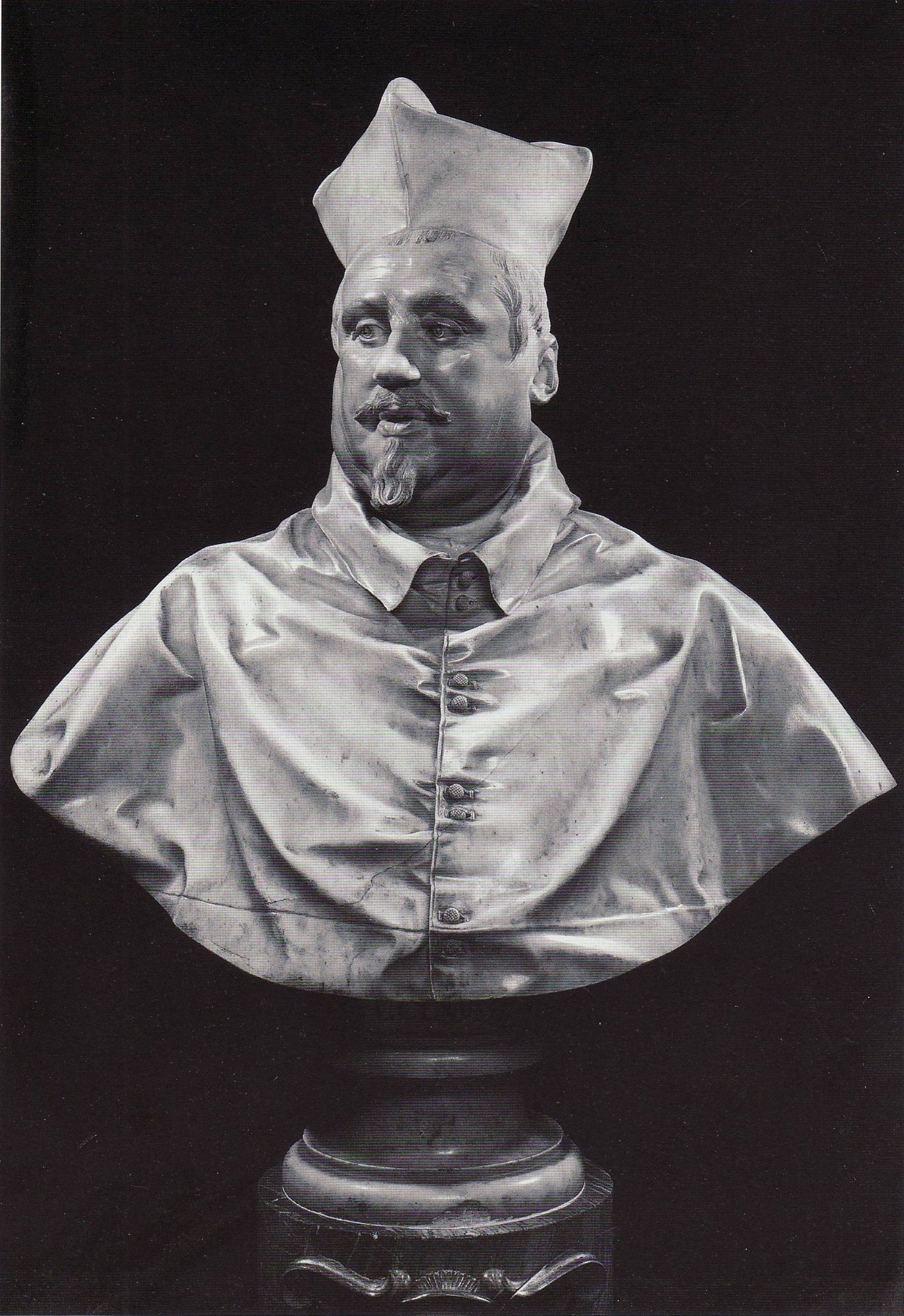
The Cesari raid is the famous story, and it deserves its own paragraph because it tells you what kind of collector Scipione was. Giuseppe Cesari, known as the Cavaliere d’Arpino, was the most fashionable painter in Rome around 1600. He had employed Caravaggio as an apprentice a decade earlier and had kept several of the young painter’s early works. In May 1607, shortly after Paul V’s election, papal officials arrived at Cesari’s studio with a warrant. The stated offense was a tax arrears dispute involving some firearms Cesari allegedly owned without a permit. The real object was the art. The bailiff confiscated the entire studio inventory, more than a hundred paintings, and transferred them as a “gift” to the pope, who then re-gifted them to his nephew. Among the pieces were a young Caravaggio self-portrait as Bacchus with grapes, and a Boy with a Basket of Fruit that now hangs in room eight of the villa.
Caravaggio himself was furious. He wrote a letter of complaint. Nothing came of it. Eighteen months later, when Caravaggio killed a man in a brawl on the Campo Marzio and fled Rome with a death sentence on his head, the only Roman willing to intercede for him at court was Scipione. In exchange, Caravaggio painted him a David and Goliath, in which Goliath’s severed head is a self-portrait of the painter. That canvas, the last Caravaggio he is known to have completed, also hangs in the villa. It was the price of a pardon that arrived too late, because Caravaggio died on a beach at Porto Ercole in 1610, on his way back to Rome to accept it.
The teenage sculptor on retainer
Scipione first noticed Bernini around 1615, when the sculptor was in his late teens and already carving portrait busts for Scipione’s father, Francesco. The commissions that followed, between 1618 and 1625, produced the four sculptures that make the villa what it is.
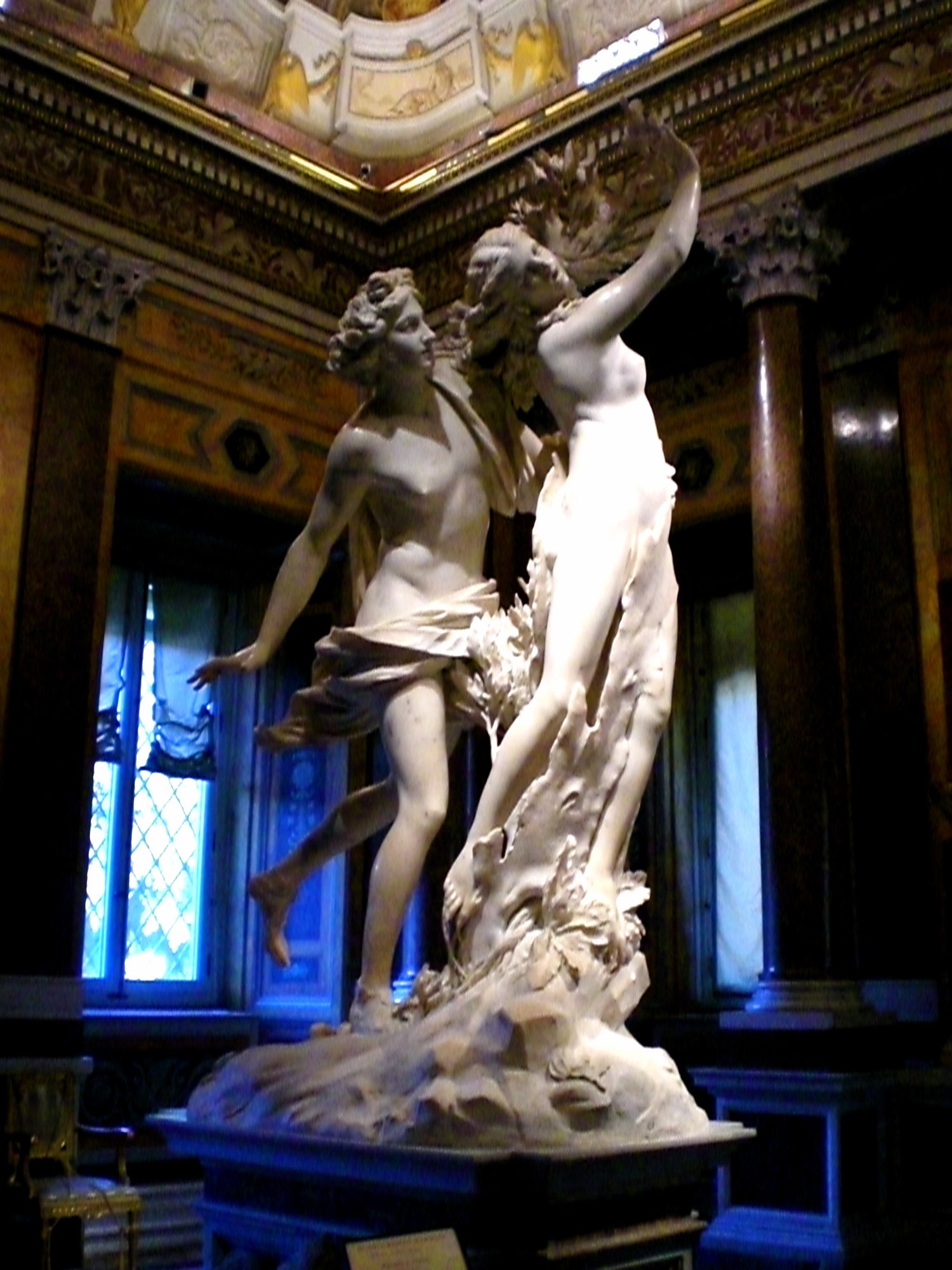
They came in this order. First, Aeneas, Anchises, and Ascanius, carved between 1618 and 1619, when Bernini was twenty. It shows Aeneas carrying his elderly father out of burning Troy, with his young son Ascanius trailing beside him. Three generations, one column of bodies, all in a single block of Carrara marble. Then The Rape of Proserpina, 1621 to 1622, when Bernini was twenty-three. Then David, 1623 to 1624, age twenty-five, the face a self-portrait of the sculptor mid-throw, jaw clenched, brow furrowed, tongue visible between the teeth. Finally Apollo and Daphne, 1622 to 1625, finished when Bernini was twenty-six, with the young nymph mid-transformation into a laurel tree, her fingers splitting into leaves, her toes sending roots into the plinth.
Scipione commissioned all four. He paid Bernini 450 scudi for Apollo and Daphne, which the cardinal then re-gifted in 1625 to his rival Cardinal Ludovico Ludovisi as a diplomatic courtesy, a decision he later reversed after Ludovisi’s death. Three of the four are in the same octagonal room today, Sala IV. You can walk around each of them in a slow counterclockwise loop in about fifteen minutes. It is the single densest fifteen minutes of sculpture in the Western world.
The painter’s ceiling above the marble
Part of what makes the Villa Pinciana different from a normal museum is that Scipione treated the interior as a continuous work. Between 1618 and 1625, while Bernini was carving downstairs, a rotating cast of painters, including Giovanni Lanfranco, Cigoli, and the Fleming Paul Bril, was covering the ceilings with fresco cycles that talk to the sculptures underneath. The ceiling above Apollo and Daphne, painted by the French artist Pierre de Cortone’s circle, shows the Council of the Gods with Apollo in the center. Look up. The room is the art. The wall labels do not tell you this and most guides skip the connection; Chiaro treats the ceiling and the sculpture beneath it as one commission, because that is how Scipione built them. It is one of the few private hoards in Europe where the building is still doing what the patron built it to do.
What happened to the Borghese collection after 1633
Scipione died in October 1633, a year after his uncle the pope. He left the villa and everything in it to his family. For a hundred and seventy years the heirs kept adding, cautiously, and occasionally subtracting. The biggest subtraction happened in 1807. A Borghese prince named Camillo had married a sister of Napoleon named Pauline. Napoleon needed art. Camillo, under pressure, sold about two hundred ancient sculptures and a number of Greek vases to his brother-in-law for around thirteen million francs. Those works went to Paris. Most of them are in the Louvre today, in a wing labeled “Collection Borghese.” The Rome villa never got them back.
But the Berninis stayed. The Caravaggios stayed. The Raphael, the Titian, the Correggio, the Canova, stayed. What you see today in the Villa Pinciana is roughly what was there in 1633, minus the Louvre chunk and plus two centuries of drift. It is about five hundred works in twenty rooms. The Italian state bought the building and its contents from the family in 1902, reopened it as a public museum, and has run it on roughly the same floor plan ever since.
Tickets, the two-hour slot, and the Villa Borghese museum
Here is the part every practical guide gets wrong. Entry works on a strict two-hour slot system, booked in advance, with entry windows every two hours starting at nine in the morning. You cannot buy a ticket at the door. You cannot extend your slot. At the end of your time, a guard walks the rooms and asks you to leave. The point of the rule is not crowd control in the usual sense, it is preservation. The climate system was designed for a place that never had more than a few dozen visitors at a time, and limiting the hourly headcount is the only way to keep the humidity from spiking.
That two-hour cap is the most common complaint in reviews. It is also, if you plan well, enough time. The building has two floors and twenty rooms. The ground floor is where the sculptures and most of the Caravaggios are. The upper floor, called the pinacoteca, is where the paintings hang: Raphael’s Entombment, Titian’s Sacred and Profane Love, the Correggio Danaë, a Veronese Saint John, a Bellini Madonna and Child. Start on the ground floor. Move counterclockwise. The Bernini room is Sala IV. Spend twenty-five minutes in that room alone and do not apologize to the people shuffling past you. When you get upstairs you will have about forty-five minutes for the pinacoteca, which is the right amount of time for a small top-floor of mostly Italian Renaissance painting.
Every writer who publishes a highlights list ends up naming the same four or five pieces, and that is not laziness, it is accurate. Apollo and Daphne is the one. Proserpina is the technical peak. David is the one that looks alive. The Caravaggio David and Goliath is the one that will stay with you after you leave.
The building sits inside the Villa Borghese park, the large green expanse to the north of the Piazza del Popolo. From the Spagna metro stop it is a fifteen-minute walk uphill through the gardens. The Villa Borghese museum, as some guides call it, is one of four museums inside the park, but the others, the Villa Giulia and the Galleria Nazionale d’Arte Moderna, have nothing to do with the Scipione collection. If someone says “Borghese museum” in Rome they almost always mean this one.
What to look for in front of the art
In Apollo and Daphne, find the place on Daphne’s outstretched right hand where the marble becomes leaf. The transition happens across about two centimeters. Bernini carved it at age twenty-six, using a drill to hollow out the space between each leaf, in a stone that wants to crack. In Proserpina, look at Pluto’s left hand pressing into Proserpina’s thigh. The marble yields. It is carved to look like flesh. In David, look at the lower lip. Bernini chewed his own lip while working, according to Irving Lavin’s biography, and the sculpture’s face is frozen mid-chew. In the Caravaggio David and Goliath, look at Goliath’s right eye. It is painted as if it were already filming over, halfway between the moment the head was severed and the moment the light left.
Kicker
The reason the collection works, four hundred years after Scipione built it, is that he commissioned the art for the rooms and refused to move any of it. The Bernini sculptures are where he set them. The Caravaggios hang where he hung them. Two hours inside a villa designed around a single afternoon of looking is the point, not the constraint.


