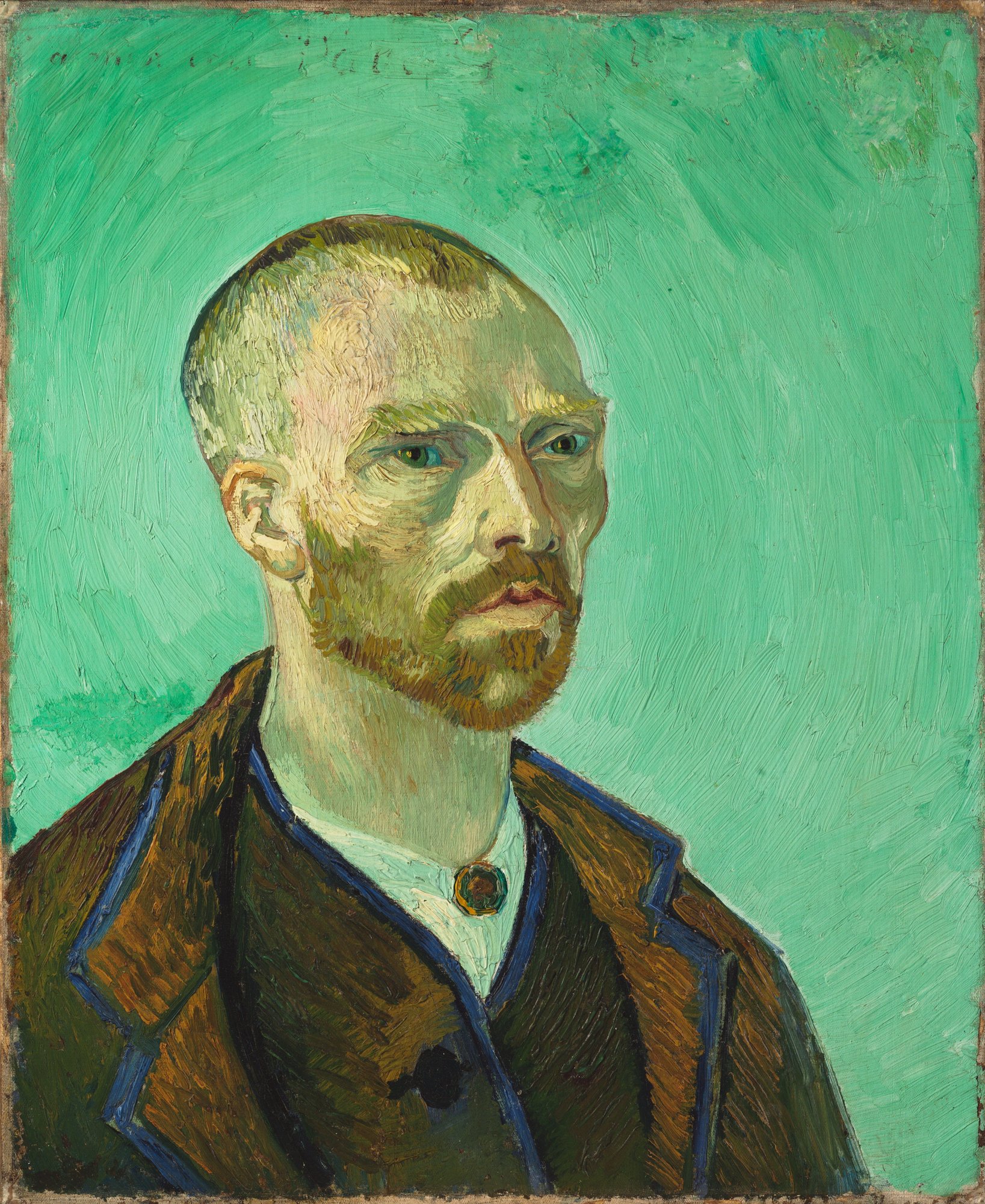
In the last week of August 1889, Vincent van Gogh walked out of his locked room at the Saint-Paul-de-Mausole asylum in Saint-Remy-de-Provence, went into the garden, and picked up a brush for the first time in almost two months. He had not painted since June 12, when a full-body seizure had torn through him and put him back in the isolation cell. Now, recovering, the first thing he chose to make was a picture of his own face. He finished it a week later. It is the painting that hangs today on the fifth floor of the Musee d’Orsay, and the story of the Van Gogh self portrait Orsay visitors queue to see is entirely the story of those four walls and the week he painted his way out of them.
There is a particular kind of quiet in the room where the Orsay keeps it. You come up the second escalator, past the Monet water lily studies and the Cezanne apples, into a small gallery lit from above. The painting is sixty five centimeters tall and fifty four wide. The background is an almost fluorescent turquoise blue, worked over in tight snaking brushstrokes that look, up close, like the surface of a shallow river seen from above. Out of this swirl comes a thin red-bearded man in a grey jacket, holding a palette and a brush. He is looking slightly past you, not at you. He is thirty six years old. He has three more months to live.
Van Gogh painted at least thirty six self portraits. Only one of them is at the Orsay. That is a small number compared to the more famous self portrait holdings of the Van Gogh Museum in Amsterdam, which has eighteen, or the Courtauld in London, which has the bandaged ear. But the Orsay has the one that matters most to the story of the last year, because it is the one he painted as proof that he could still paint at all.
The week Van Gogh got his brushes back
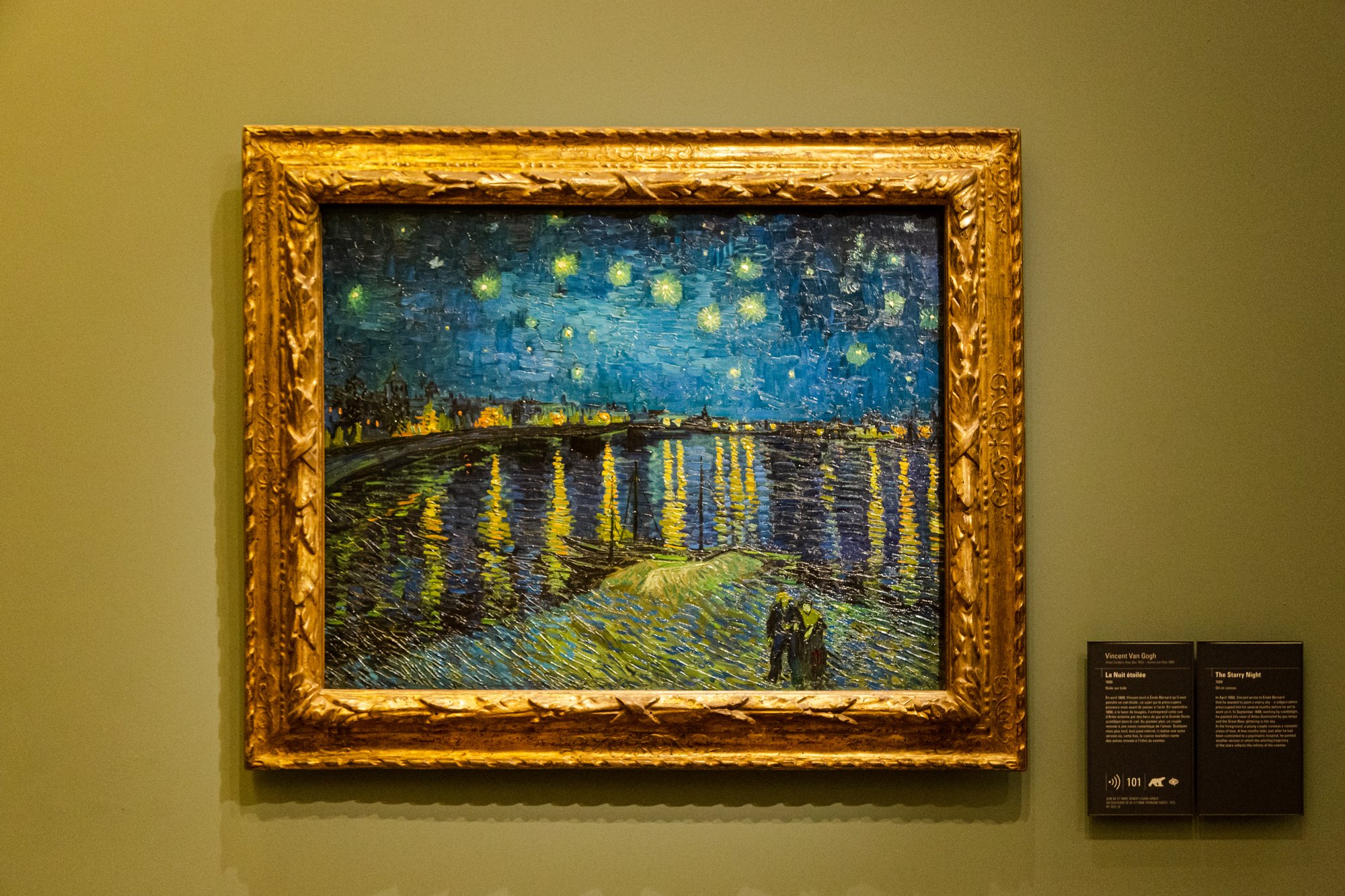
Here is the sequence, because the dates matter. Van Gogh committed himself voluntarily to the Saint-Paul asylum in Saint-Remy on May 8, 1889, after eight months of crises in Arles that had included the ear cutting on December 23, 1888. For his first two months at the asylum he was productive. He painted the Irises. He painted the olive groves. He painted Starry Night from his second floor bedroom window in the middle of June.
Then on July 14 he had a seizure. Hospital records from Dr. Theophile Peyron describe a full attack that left him unable to speak. He was moved into a locked room. His brushes and his colors were confiscated for his own safety, because during previous episodes he had tried to eat his paints. He stayed in that room for five and a half weeks. He wrote no letters. He made no drawings. When he finally recovered, in the last days of August, he wrote to his brother Theo on August 22 that he was “astounded at being unable to understand the last six weeks.”
On September 5 or 6, Peyron returned his painting equipment. The very first thing he made was a self portrait. Three days later he made a second one. The second is the one at the Orsay.
What Van Gogh actually wrote about it
You do not have to guess at his intentions for this painting. We have the letter. On September 10, 1889, two days after finishing it, Van Gogh wrote to Theo and described the picture in detail.
“You will see, I hope,” he wrote, “that my face is much calmer, although it seems to me that my look is vaguer than before.” He described the background: “hard ashen grey” at first, rising into a “pale malachite” green. The jacket, he noted, was “violet darkened to pure prussian blue.” He was proud of one specific detail: “One must look at it from a distance.” The close-up jumble of the brushwork, he was saying, was meant to resolve into something coherent from six or eight feet back.
He told Theo something else that day. “People say, and I am quite willing to believe, that it is difficult to know oneself — but it is not easy to paint oneself either.” He had painted himself, in that specific week, as a way of checking whether he was still there.
The Orsay painting is the only self portrait he ever made of himself as a painter — holding the palette and brush, showing the tool. Every other one is just the face. This is the only one where he shows himself working.
The Van Gogh self portrait Orsay mirror
Stand five feet back and look at the face. The cheeks are drawn in tight with a high boned forehead. The beard is shorter than in the Arles self portraits, cut back to near-stubble. The eyes are set deep and lit from the viewer’s left with a pale yellow that matches the pigments on the palette in his hand. He is wearing the grey jacket he arrived at the asylum in. His collar is buttoned all the way up, a formal detail for a man who lived in shirtsleeves in Arles.
The background is where most of the energy of the picture sits. Van Gogh worked it in what historians now call the “Saint-Remy brushstroke”: short curving marks laid parallel and nearly touching, giving the whole field a kind of slow rotating weather. You can see the same marks, larger and more violent, in the Starry Night he had painted three months earlier. Here they are smaller, calmer, almost decorative. He told Theo the color was “the pale malachite green of a summer sky after a storm.” What he did not tell Theo is that you can see the physical pressure of his hand in every stroke. He was working fast.
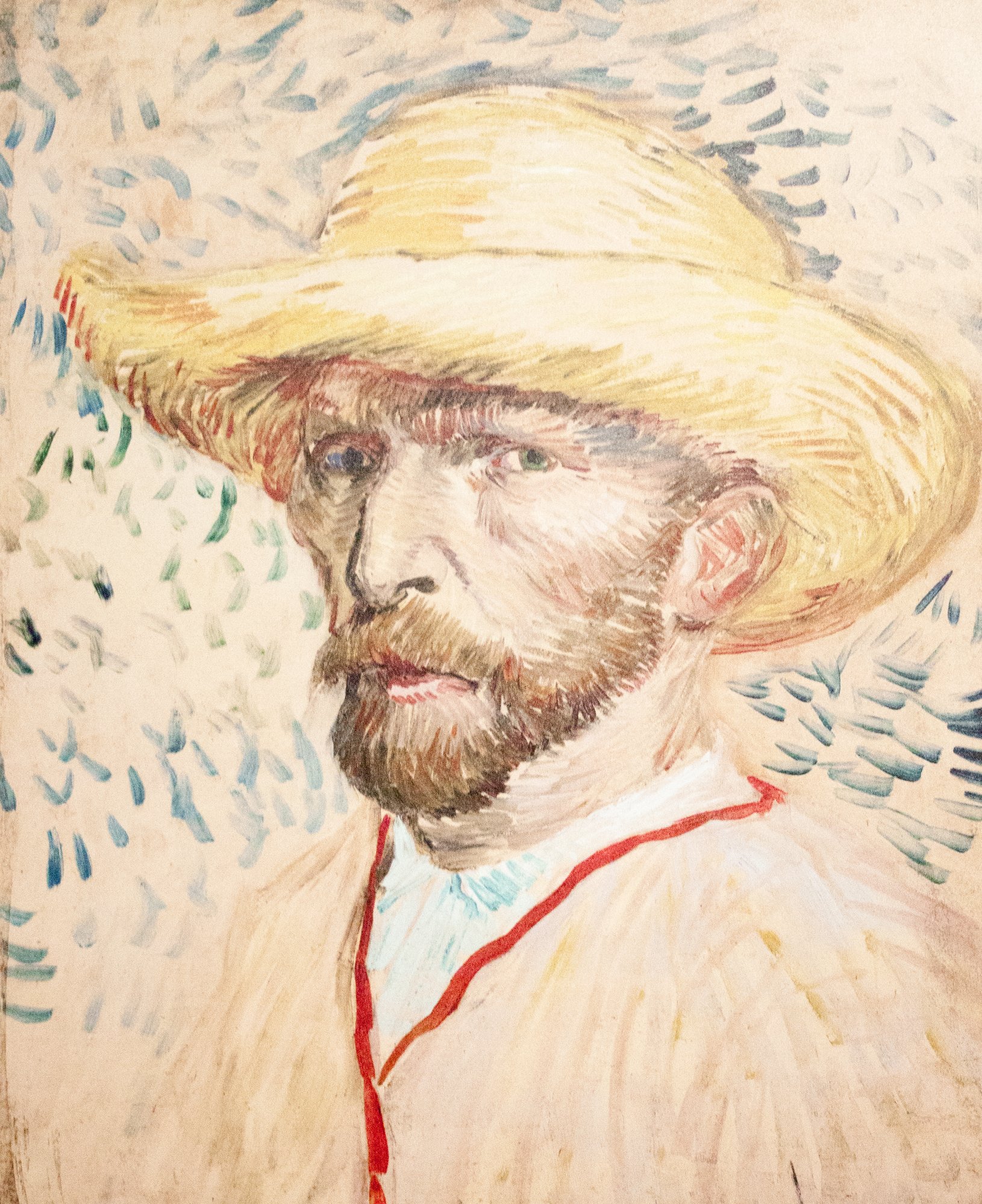
Compare this painting to the 1887 self portrait from Paris, which is also in the Orsay’s collection but not always on view. In Paris Van Gogh painted himself in fractured blue and orange dots, borrowing from Seurat. He looks startled and young. Two and a half years later, in the Saint-Remy painting, the dots have become snakes and the face has gone hollow. The two pictures are the same man looking at himself in different mirrors on different coasts of a breakdown.
Why there are so many Van Gogh self portraits
He painted himself thirty six times in ten years. The short answer for why is simple and almost boring. He could not afford models. A professional sitter in Paris in the 1880s cost fifty centimes to a franc per hour. Van Gogh lived on an allowance from Theo of 150 francs a month. He could not hire people, and people in small French towns often refused to sit for him for free because he was considered strange. So he used the only model available for no money, which was the man in his bathroom mirror.
There is also a less practical reason, which he named himself in a letter from Arles in 1888. He wrote that the self portrait was a way of “studying oneself as one studies one’s family.” He thought of the mirror as an ethnographic tool. Each painting was a field note on a difficult subject.
This Van Gogh Saint Remy self portrait is the last field note. It is effectively the Van Gogh last self portrait of his working life. He did one more after it, a smaller unfinished one sometimes dated to November 1889, and then he stopped. He got on a train to Auvers-sur-Oise in May 1890. He shot himself in a wheat field on July 27, 1890, and died two days later. The Orsay painting is, for all practical purposes, the last time he looked in the mirror and recorded what he saw.
How the painting got to the Orsay
Theo inherited everything in Van Gogh’s studio, then died in January 1891 of syphilis. Theo’s widow, Johanna van Gogh-Bonger, inherited the works. She was twenty eight years old, pregnant with Theo’s son, and about to spend the next thirty three years single-handedly building Vincent’s posthumous reputation by writing letters, organizing shows, and refusing to sell the best paintings until museums would accept them for what they were.
She kept the 1889 self portrait in her personal collection. When she died in 1925, it passed to her son Vincent Willem van Gogh, who ran the family holdings until 1949. In 1949 he donated the painting to the French state in the name of his uncle. It went first to the Louvre. It hung in the Jeu de Paume gallery in the Tuileries starting in 1951, in the room of French Impressionists the Louvre had never figured out where to put. When the Orsay opened in December 1986, the entire Jeu de Paume collection walked across the Place de la Concorde and up the riverbank to the new building. The self portrait went with it.
It has hung on the fifth floor of the Orsay, behind the great clock, without interruption since 1986, except for a few loan periods for retrospectives.
What to look for up close
Give it at least three minutes. The picture rewards slow looking in specific ways.
First look at the palette in his hand. The actual pigments visible on it are mostly the same colors he used to paint the background: the malachite green, a rose pink, a lemon yellow, and a small patch of vermilion red near his thumb. He painted his own tools with his own tools. It is a tight little loop that only rewards the close reader.
Second, look at the eyes. They are not quite focused on you. Van Gogh is looking at a spot in the mirror about six inches to the left of where your face would be if you were standing where he stood. That small offset is what gives the painting its particular feeling of absence. He is present, but not at you.
Third, step back. Walk five paces toward the far wall of the gallery and turn around. The whole picture resolves. The tight little marks in the background soften into pure color. The face comes forward. The jacket goes to blue. This is the effect he told Theo he was after when he wrote “One must look at it from a distance.” Most visitors never do. They crowd in close and miss the painting he actually wanted them to see. If you are going to stand at the far wall anyway, Chiaro has the September 10 letter to Theo read out in his own words while you look.
Fourth, think about the timing. He painted this in the second week of September 1889. He had fifteen weeks to live in Saint-Remy, three weeks to live in Auvers, and then the pistol shot in the wheat field. The painter of this face did not know that. He thought he was getting better. In his letter to Theo the same week he wrote, “I hope the attack will not return.” It returned, twice more, before the end.
The other Van Gogh self portrait most people miss
The Orsay has a second Van Gogh self portrait. It is the 1887 one from his Paris period, the one with the fractured blue and orange dots and the straw boater. It is smaller, lighter, more experimental, and it hangs in a different room from the 1889 one. Most visitors see the 1889 and leave. If you want the full arc, hunt down the 1887 first. You will see Van Gogh still learning to paint himself, still borrowing from the Parisian Neo-Impressionists, his beard a little wild, his eyes still optimistic. Then walk to the 1889. The two paintings thirty feet apart are the start and end of a man watching himself change in a mirror.
Kicker
The last Van Gogh self portrait at the Orsay is not about mental illness, and it is not about tragedy, even though both those words come up in every label written about it. It is about a man sitting in a garden in September after a bad summer, picking up his brushes again, looking in a mirror, and making a picture good enough to convince himself and his brother that he was still a painter.
The label on the Orsay fifth floor will tell you the date. It will not tell you what week of his life the painting came from. He left more notes than any painter in history; the Orsay portrait is the one week he put the notes down and held the tool up.
Image credits
- The Starry Night by Vincent Van Gogh (52254965920).jpg — Adrian Scottow from London, England. Source, CC BY-SA.
.jpg)