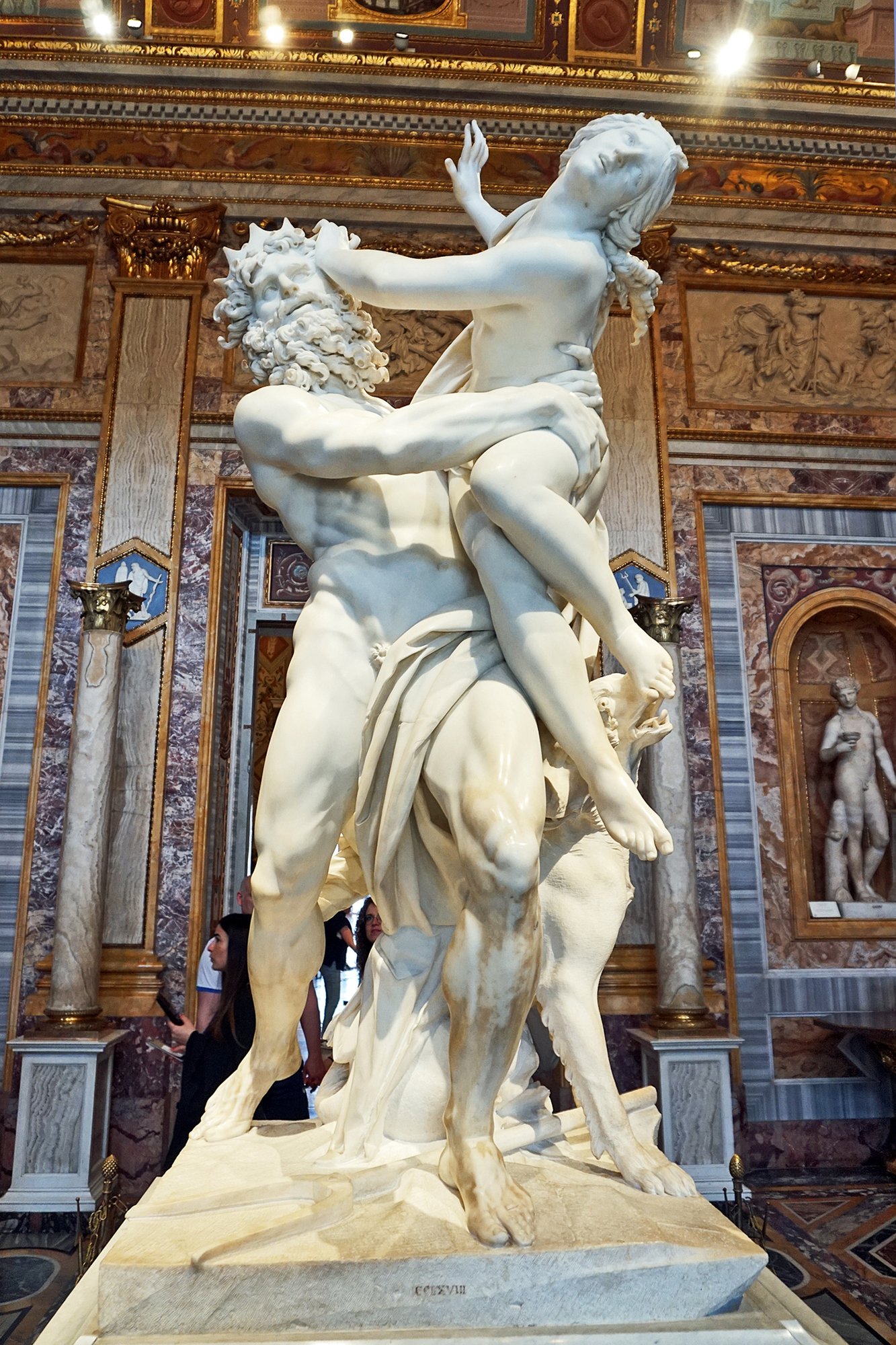
The Rape of Proserpina Bernini carved for Cardinal Scipione Borghese in 1622 has a detail that most people miss until they see it, and then they don’t see anything else. Pluto’s right hand is on Proserpina’s thigh. His fingers are pressing into her skin. Her skin is giving. You can count four small dimples in her flesh where his fingertips push in, and a fifth crease behind his thumb. The thigh is marble. The hand is marble. The dimples are marble. The softness is a lie told so well that your eye refuses to see it.
Gian Lorenzo Bernini was twenty-three years old when he finished the piece. It was his second commission from Cardinal Scipione, coming between the Aeneas and Anchises group of 1619 and the Apollo and Daphne he would start in the same year. The cardinal paid him four hundred and fifty scudi. It was a bargain.
Why the Rape of Proserpina Bernini still shocks
The scene is from Ovid, book five of the Metamorphoses. Pluto, god of the underworld, has decided he wants a wife, and Venus has pointed Cupid at him. Cupid fires. Pluto looks up, sees Proserpina, the daughter of Ceres, picking flowers in a field in Sicily, and he takes her. He hitches his black horses, breaks the ground open, and drags her down to the underworld through the torn earth. Her mother Ceres spends six months looking for her. By the time Ceres finds out where she is, Proserpina has eaten six pomegranate seeds, which binds her to the underworld for six months of every year.
That is winter, in the Roman story. Winter is the months Proserpina is gone.
Bernini took the moment just after Pluto has grabbed her. She is twisting, trying to get away. Her left hand is pressing against the side of his face, her fingers splayed across his forehead, shoving. Her right arm is flung back, and she is crying. A marble tear is on her cheek. Her head is turned to the right, away from him, her mouth open in a small round shape. Pluto is lifting her up. His right hand is holding her thigh from underneath. His left arm is locked around her waist. He is half-laughing. He has a huge curling beard and three-headed Cerberus is barking at his feet.
All of it is cut from one four-ton block of Carrara marble.
The fingers, which are the entire point
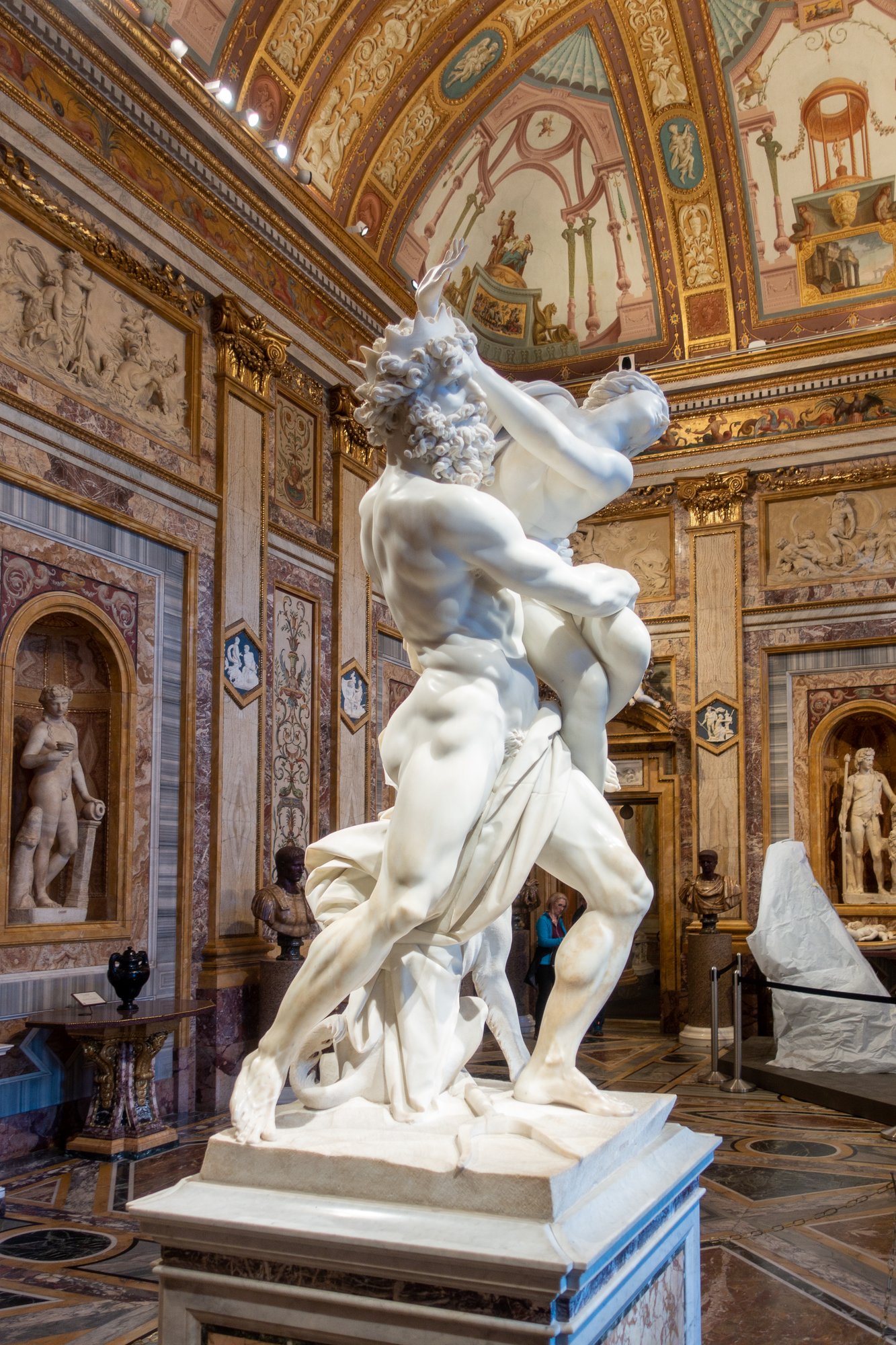
Go to the Galleria Borghese. Walk to room four. Walk around the piece to the right side, because that is where the famous detail lives. Get down so the thigh is at eye level. Stop.
You will see four marble fingers pushing into a marble thigh, and the marble thigh is dimpling under them. There is no technical precedent for this in the history of sculpture. Michelangelo’s figures have taut flesh and visible muscle and superb anatomy, but nobody touches anybody in Michelangelo. A finger never pushes another figure’s body the way a hand pushes into dough. Bernini did. He invented the Bernini fingers in marble effect for this sculpture, and he refined it for the rest of his career, but this is where it starts.
The method is stone abrasion. You carve the hand and the thigh as one unit, polish them until they blend seamlessly, and then you use progressively finer abrasives — pumice, tripoli, cloth, straw — to create the softening where the thumb meets the leg. The softer the polish, the more light scatters on the surface, and the more the marble reads as skin. The hand itself is polished to a slightly different finish. Your eye reads two materials. It is reading one block of stone.
A sculptor who saw Bernini’s finished piece before it left the workshop is said to have walked around it three times and then asked where the seam was. There is no seam. Get down to the thigh with Chiaro running and the polishing sequence gets described while you look at the dimples, which is the only way a detail this small makes sense.
The Pluto and Proserpina sculpture was commissioned cold
The patron was Cardinal Scipione Borghese. Scipione had two habits. He commissioned sculpture at a rate that would bankrupt any private collector, and he gave things away when a politically more powerful person expressed interest. A year after the sculpture was finished, Scipione gave it to Cardinal Ludovico Ludovisi, the nephew of the new pope Gregory XV, as what contemporaries plainly called a bribe. Ludovisi took it to the Villa Ludovisi, where it stood for almost three hundred years. The Italian state bought the villa’s art in 1908, and the sculpture came back to the Galleria Borghese, to the room where you can stand in front of it now.
Scipione gave away one of the greatest marble sculptures of the century. It didn’t even cost him Bernini, because Bernini was already on retainer for the next commission.
Proserpina’s face, which most people skip
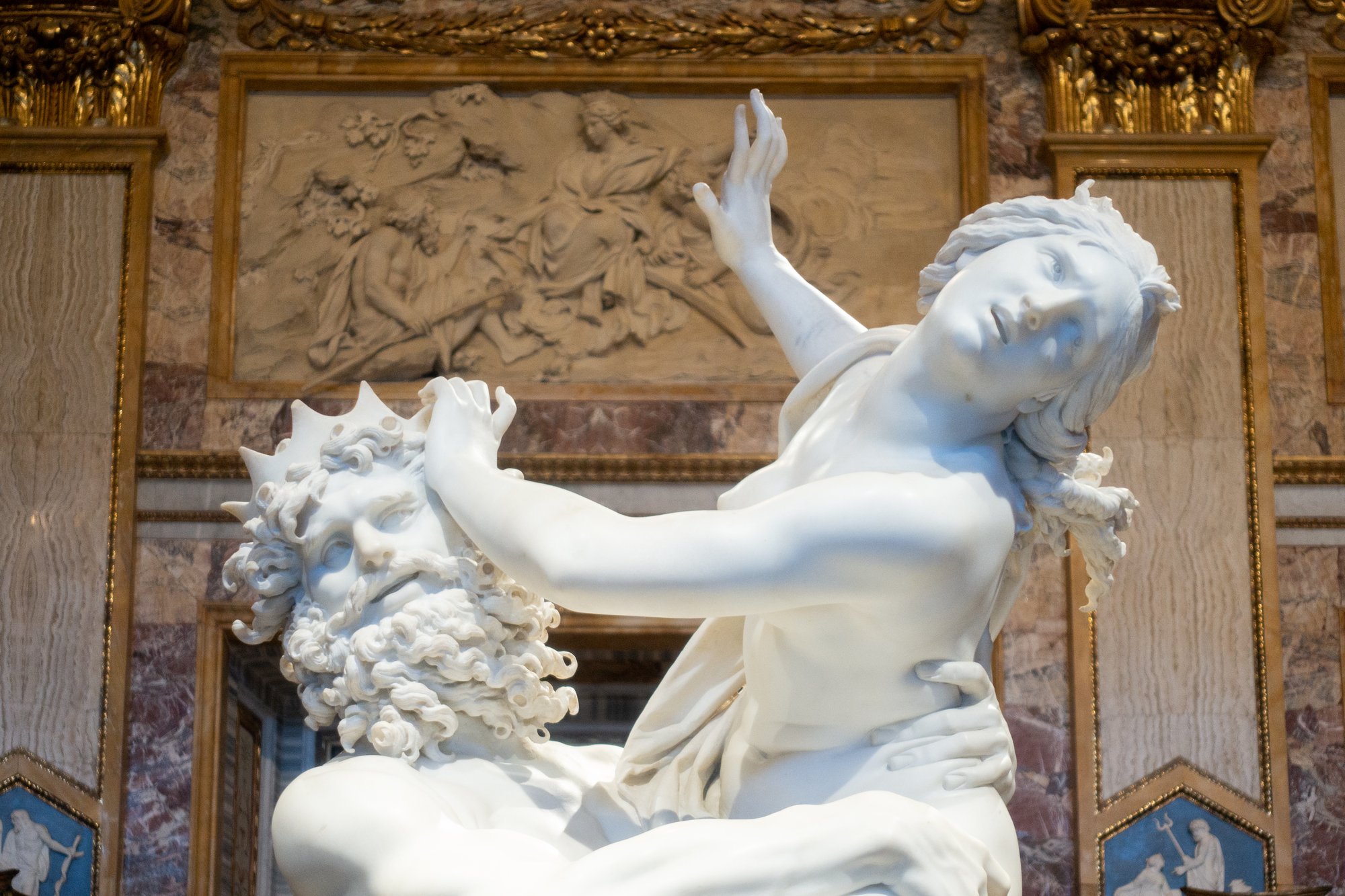
Everyone looks at the hand. They forget to look at her face. Look at her face.
Proserpina is crying. There is a single carved tear on her right cheek. She is pushing Pluto’s head with her left hand, and her fingers are splayed so wide that you can see every knuckle. Her mouth is a round shape, frozen in the moment a sound is coming out. The sound is probably “no.” The audio of the scream is written into the stone.
What the young sculptor has done — and nobody was doing this in 1622 — is attach a specific emotion to a specific face. Before him, mythological figures wore generic expressions. Ovid is full of weeping women, but the weeping is usually indicated through gesture and pose, not through a face that actually looks like someone being grabbed. Bernini gave Proserpina a face. A face with a mouth frozen in mid-scream.
You can hear the sculpture if you stand close enough. That is the point.
Bernini proserpina 1621 and the Latin couplet
The sculpture was carved between 1621 and 1622. Like the Apollo and Daphne that followed it, it got a Latin couplet on the base, written by Maffeo Barberini, future Pope Urban VIII, to give moral cover to a cardinal who was displaying a violent pagan scene in his villa. The inscription reads, roughly: “Whoever you are, who lift up to your eyes a Proserpina plucked by Pluto, see the goddess of harvest, Ceres, follow in grief.” It is a moralizing frame for a piece that is really about how marble can behave like flesh.
Urban VIII would later become Bernini’s biggest patron. He commissioned the baldacchino in St Peter’s, the tomb of Urban VIII, the Triton Fountain. Writing Latin verse for the base of a young sculptor’s first great work was how that relationship started.
Proserpina statue Bernini and the question of movement
The composition runs on three axes. Pluto’s body is moving forward, to the left. Proserpina is twisting backward, away from him. Her torso and his torso are turning in opposite directions, which creates the diagonal spiral up through the piece that your eye follows from Cerberus at the bottom to her hand on Pluto’s head at the top. Bernini would build this figura serpentinata principle into almost every sculpture he made afterward.
He also built narrative viewpoints into the piece. Stand in front and you see Pluto triumphant, carrying off a struggling woman. Stand to the right and the story changes: her splayed fingers on his forehead are shoving, her mouth is open, his expression stiffens. Walk to the left and all you see is her grief and the strange gentleness of his grip. Every angle tells a different story. Bernini was twenty-three, and he had already solved a compositional problem that had stymied sculptors for two centuries.
The marble technique: polish and drill
There are two technical tricks holding this sculpture together.
The first is the polish, which does the softness. The second is the drill. Bernini used the bow drill for all the places where stone needs to become hair or fabric or beard. Pluto’s beard is about a foot of drill-work. The hairs of his head are separately grooved. Cerberus’s three heads have snarling mouths with individually drilled teeth. The drill is what turns solid marble into the look of texture. Before Bernini, sculptors used the drill sparingly. He pushed it to the point where the piece looks hairier and more fabric-covered than its own weight should allow.
This is also where he uses undercut. Fabric appears to lift off the body, toes to clear the ground, fingers to float above the leg. The undercutting is engineering. It would shatter in anyone else’s hands. Bernini was reading the stone’s grain, and he was placing the cuts on the axes where the marble could hold.
What to look for in front of it
Four things.
First, the fingers on the thigh. Get low. Stand to the right. Find the dimples.
Second, Proserpina’s tear. The tear is on her right cheek, carved as a single drop.
Third, her splayed left hand on Pluto’s face. Look at how the fingers bend around his forehead. Her pinky is almost detached from the skull. It is hanging in undercut air, held by a millimeter of stone.
Fourth, Cerberus at the bottom. Three heads. The middle one is snarling, the left one is howling, the right one is barking. None of them look the same.
The Borghese Proserpina and what it started
The Borghese Proserpina is not Bernini’s most famous sculpture. The Apollo and Daphne in the next room has the leaves; the Ecstasy of Saint Teresa has the drama; the fountains in the piazzas have the scale. But this sculpture is where he solved the problem that made him Bernini. He figured out how to make a thigh look soft, a hand look heavy, a tear look wet, and a twenty-three-year-old’s name stick inside the Borghese family for four hundred years.
Everything he did after this piece is built on the dimples in Proserpina’s thigh.
Kicker
Four fingers pressing in. A carved tear. A twenty-three-year-old who figured out that marble could be taught to lie. That is the piece in room four of the Galleria Borghese, and nothing carved before it is quite the same afterward.

.jpg)
.jpg)