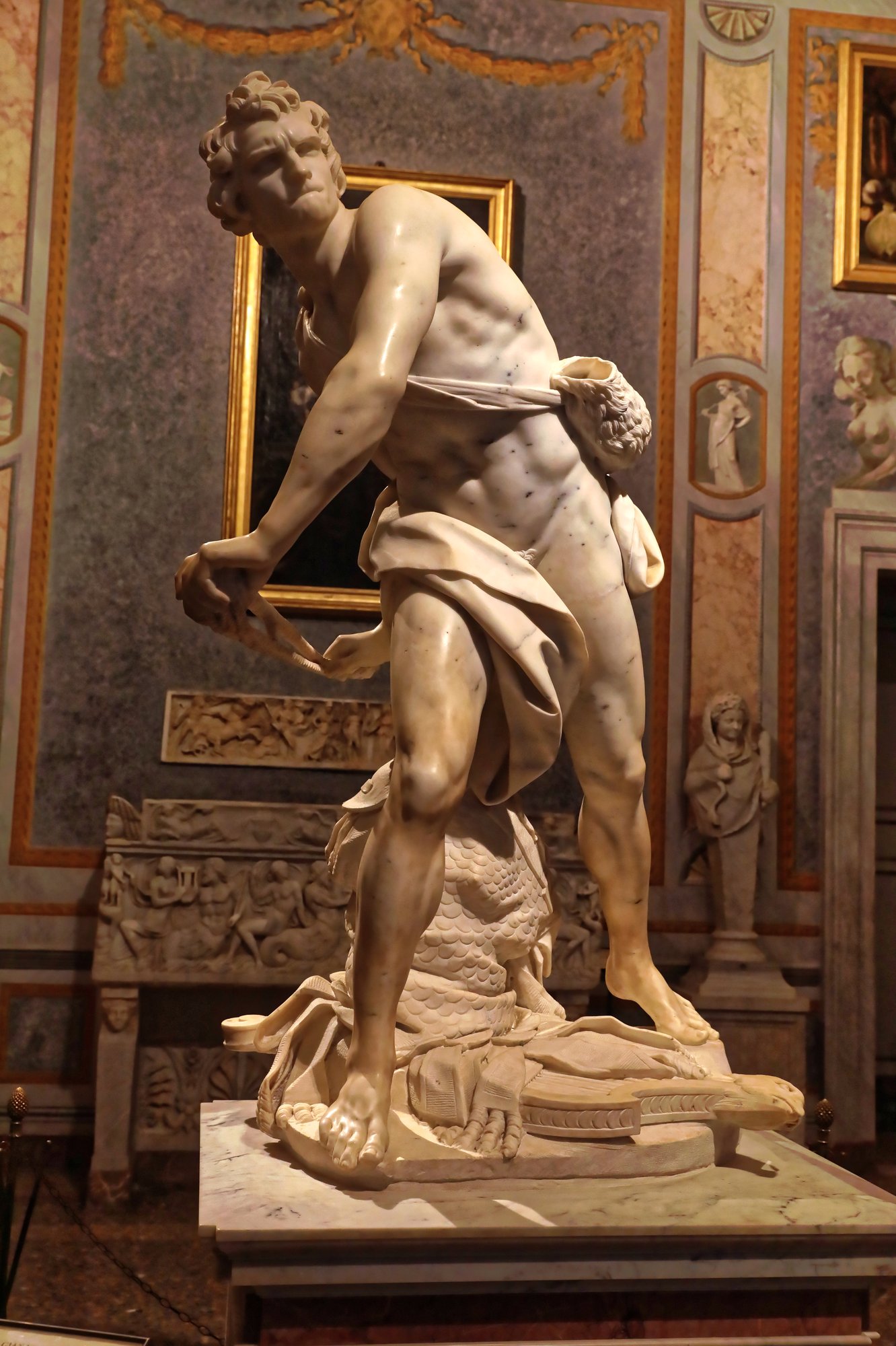
The Bernini David sculpture in the Galleria Borghese is a self-portrait. Stand in front of it. Look at the face. The brow is furrowed. The eyes are narrowed. The lower lip is caught between the teeth, hard enough that you can see the pressure in the cheek muscles. Now look at the engraving of Gian Lorenzo Bernini from around 1623, the one Ottavio Leoni drew from life. It is the same face. Same brow, same jaw, same lip. The sculptor was twenty-five years old, and he was carving himself.
Cardinal Scipione Borghese held a mirror for him while he worked. That detail comes from Filippo Baldinucci, who wrote the first biography of the sculptor and got the story from people who had been in the workshop. Scipione, who was in his fifties, stood patiently with a mirror while the young artist chiseled the face of a shepherd-king who was about to kill a giant. That was how the commission that started in 1623 got its face.
Why the Bernini David Borghese rewrites the subject
Everybody knew what David looked like. Donatello had made him as a dreamy, naked adolescent in 1440. Verrocchio made him as a cocky teenager in 1473 with Goliath’s head at his feet. Michelangelo’s David, of course, stood in Florence from 1504 on, seventeen feet tall, beautiful, calm, poised before the fight. Every David before 1623 was waiting. Either they had already killed Goliath and were posing over the corpse, or they hadn’t killed him yet and were thinking about it.
The young sculptor threw that out. His David is in the middle of the throw. The torso is twisted full round. The right arm is drawn back, the left arm is forward, the weight is shifted onto the back leg, the slingshot is loaded and ready to snap forward. The figure is an athlete six inches into a spinning motion. A second later, the stone will be in the air. The statue is not a portrait of David. It is a portrait of one second of David’s life.
Bernini was twenty-five. He had just finished the Apollo and Daphne and the Pluto and Proserpina. This was his fourth major commission for Scipione. He carved it in seven months. It is the only David in the history of art where you feel the shot is coming.
The face, which is also the sculptor’s
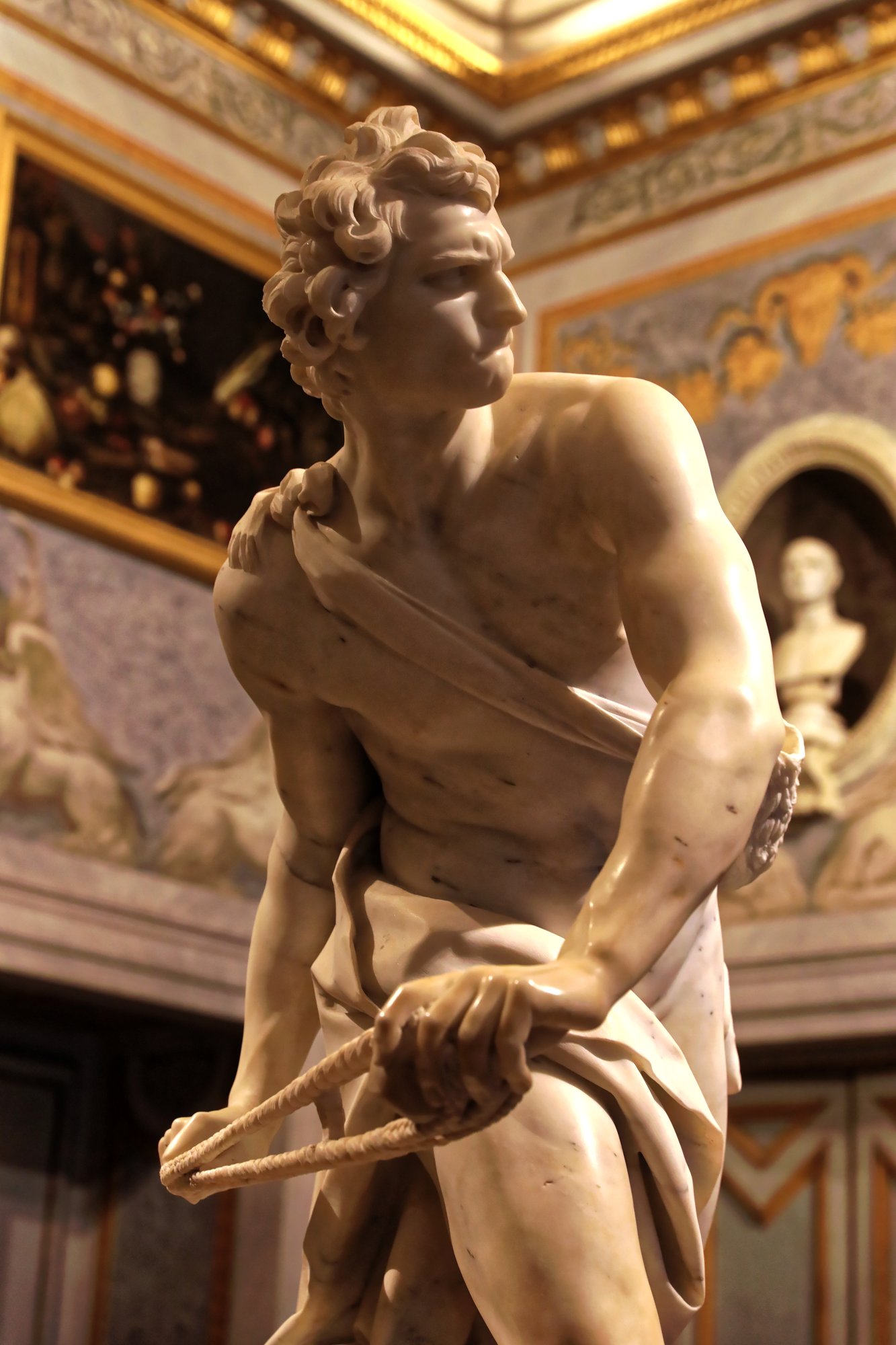
Look at the lower lip. It is being bitten. You can see the crease of the teeth on it. This is the most specific physical detail in the entire figure. Marble does not usually have crushed lips. Classical statues have lips parted, or pressed flat, or slightly open. Nobody was chewing on themselves. The sculptor carved this exact bite from his own mouth. The jaw muscle is tightened on the right side. The neck is tense. The brow is down.
Baldinucci wrote that Scipione held the mirror, but the story behind the story is this: a model holding a pose for the months of work would have been smiling or unfocused inside of ten minutes. The only person who could sustain the concentration, the fury, the about-to-act tension for months of intermittent sittings was the artist himself. So he looked at his own face. The mirror is not decoration. It is the tool that made the sculpture possible. Chiaro reads the Baldinucci passage in full in front of the face, which is the only place the mirror story actually lands.
There is one other source detail. On the ground behind the figure, there is a small harp. Old Testament David was a harpist. The harp is inlaid with a tiny carving of an eagle, which is the heraldic animal of the Borghese family. The cardinal’s family crest is hidden in the prop. The sculpture is both a self-portrait of the artist and a coded portrait of the patron.
Against Michelangelo, and what actually changed
Put them next to each other in your head. Michelangelo’s David, finished 1504, is a nude man standing still, looking to the left, slingshot over his left shoulder. His body is in contrapposto. His muscles are relaxed. His face is expressionless. You cannot tell if he has already fought or is about to fight. Michelangelo took the pause before action. He carved a boy imagining a future battle.
Bernini’s version, finished 1624, is a nude man in mid-spin. The composition is diagonal. The limbs are asymmetric. The muscles are tensed. The face is twisted into concentration. He is about to throw a rock at an armored man eight feet tall. There is no pause. There is a second of violence being compressed into stone.
The difference is not just technique. It is philosophy. Michelangelo saw sculpture as the extraction of the perfect form from the block: you release the figure that is already inside. The body at rest is the body at its most essential. Bernini saw sculpture as the capture of a moment: the one second in a person’s life when everything they are is visible in the body. Force, fear, will, decision, all squeezed into a pose. Michelangelo carves the soul. The other carves the nervous system.
Both approaches are right. But a baroque david sculpture in motion is a harder technical problem, and the young artist solved it at twenty-five.
How a stone man gets in motion
There are two engineering tricks holding the sculpture up.
First, the stance. The figure is balanced on two feet, but one foot is planted flat and the other is on its toes, with the heel lifted. The weight shifts from the front leg onto the back leg during the throw, which is physically correct. A real person loading a sling shifts the way the figure does. So the stone is showing you an accurate biomechanical moment, and Bernini knew the biomechanics because he had presumably tried the motion himself. You don’t carve this pose from imagination.
Second, the undercut. The slingshot is held in the left hand, drawn across the body, and the stone is loaded in its pocket. The pocket is deep. The hand is gripping fabric. The arm is pulled back tight against the ribs. The entire left arm and the slingshot are carved free of the torso, which means there is air between the arm and the body. If you look from the side, light passes through the gap. This is a cantilevered piece of marble holding its own weight in mid-motion, over four hundred years now without a crack.
The 1624 inscription the patron ordered
A Latin couplet was carved on the pedestal, of course. It was not written by Maffeo Barberini this time, because Barberini had just become pope and was busy. Scipione Borghese commissioned the couplet elsewhere, and the inscription reads, roughly: “Because of innocent simplicity, David threw a stone from his sling, and laid the giant flat.” The phrase that does the work there is innocent simplicity. The sculpture is anything but simple. But the patron needed the public reading to be religious: humble David, empowered by God, defeats Goliath. The marble figure is about violence, concentration, rage. The base is about humility.
This is what Roman cardinals did in the 1620s. They commissioned pagan and biblical subjects of extraordinary physical force, and then they bolted moralizing Latin couplets onto the base, so the piece could live inside a Christian household. The couplets were a kind of censor’s license.
What the body is doing from every angle
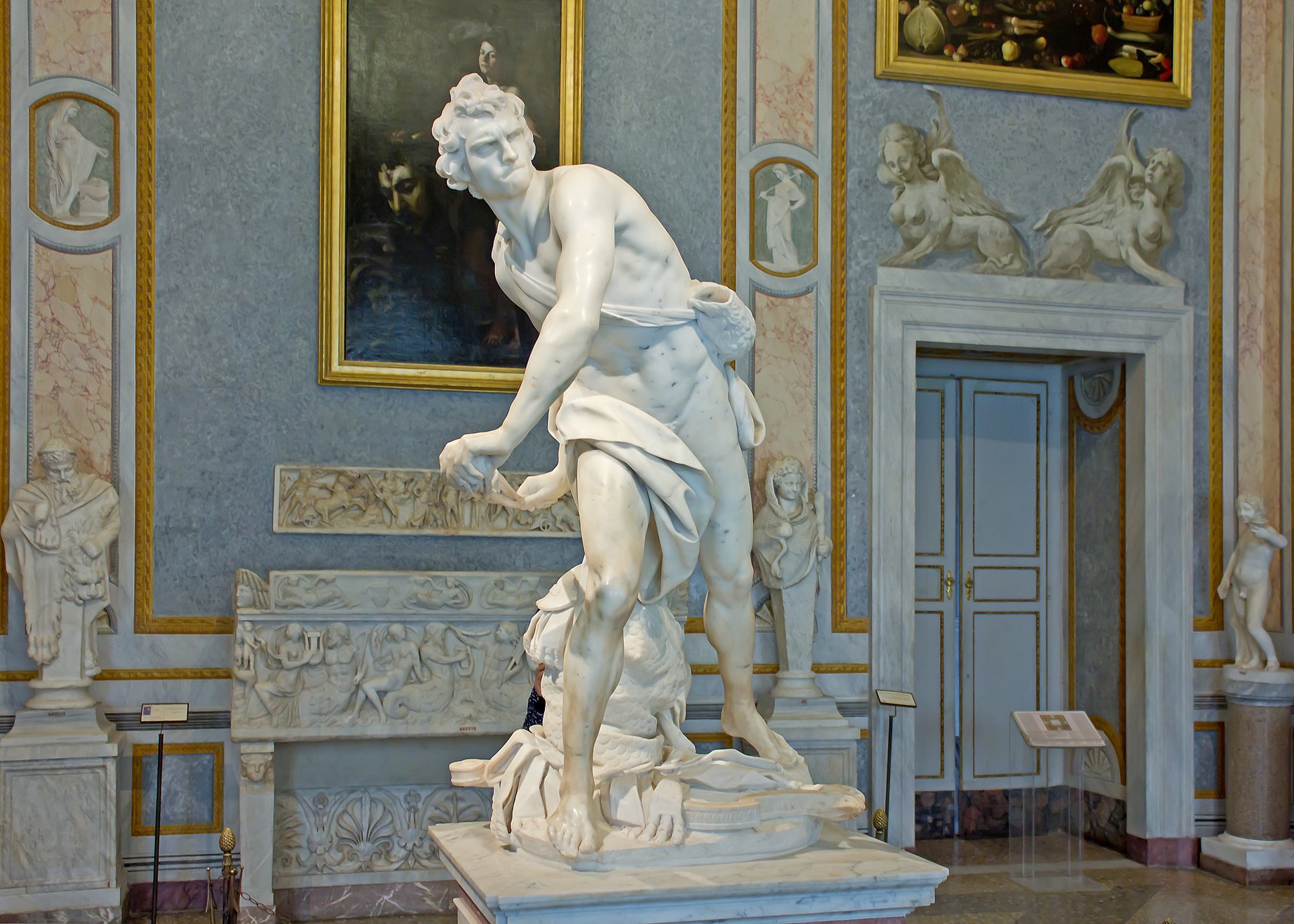
Walk around it. This is the third Scipione commission in a row that was designed to be circled. From the front, you see the throw beginning: the right hand drawn back with the sling cord, the eyes locked on the target. From the left side, you see the whole coiled torso and the compressed energy of the pose. From behind, you see the shoulder blades pulled together and the tendons running up the right arm. From the right, you see the face in profile, biting down, and the slingshot across the chest.
Every angle shows something different the body is doing. The sculptor made him a figure that rewards a full walk-around, not just a frontal view. That was a deliberate break from the classical and Renaissance tradition, where sculpture had a principal view. A Michelangelo David has one face. This one has four.
One more detail most visitors miss. The armor of Saul, which David refuses to wear in the Bible, is piled at his feet. A breastplate, a helmet, leg armor. Ready, rejected, and left on the ground. Bernini carved the armor because it is part of the story, but he buried it at the base so you do not see it on first look. You have to look down.
Why this version still feels modern
The reason the sculpture does not read as a seventeenth-century work, even though it is, is that Bernini solved the problem of carving muscular tension and emotional focus at the same moment. Most sculptures give you one or the other. Either the body is expressive and the face is blank, like ancient Greek athletes, or the face is expressive and the body is stiff, like medieval saints. He made a figure where every square inch is doing the same emotional work: the back of the neck, the fingers, the abdomen, the brow. Every part of this nude body is about to throw.
You can see the sculpture now in Room Three of the Galleria Borghese, next to the Apollo and Daphne and across from the Proserpina. The three pieces together are a single artist’s run from twenty-one to twenty-five, which makes them the most productive four years in the history of sculpture.
What to look for when you visit
Four things.
First, the face. Get close. Look at the lower lip. Compare that face to any portrait of Gian Lorenzo Bernini. Same face.
Second, the hands. The right hand has the sling cord pinched between thumb and forefinger. The left hand is gripping the loaded pouch. Both grips are correct. This is a sculpture of someone who knows how a sling works.
Third, the feet. Look at the back heel lifted. That is the motion about to complete. The sculpture is a second before release.
Fourth, the harp behind him. Find the eagle. That is the patron winking at you.
Kicker
A bitten lip. A loaded sling. A twenty-five-year-old staring into a mirror held up by a cardinal and carving the face he saw. That is seven months of work that rewrote what David could look like in stone.

